We’re here for you
Make an appointment for a non-binding consultation or if you have any questions, just give us a call.

header.search.error
Emptying the dishwasher or cleaning the windows: Should children receive money for doing jobs at home? Tips and recommendations for parents and guardians on the subject of money and chores around the house.

Nobody has sorted out the waste paper yet again. The child’s room is a mess, and the parents have been left to empty the dishwasher. It’s hard to make a family chore schedule work. Would it perhaps solve the problem if the children were given pocket money for chores?
There is a great temptation to link pocket money to chores and tasks around the home to make sure that children lend a hand. However, parents should be careful: educational experts recommend paying pocket money regularly, without being prompted and unconditionally. It should be used as a learning tool for financial education and not as a punishment.
On the other hand, children should not be paid for doing everyday household tasks, such as tidying their room or washing up. This is because these activities are part of the child’s “duty” to help their parents. The aim is to strengthen the children’s sense of responsibility within the family.
Pocket money is a learning tool and not a reward for chores. Your child should realize that they are helping out the family, not doing jobs for money.
If the child helps somebody else, for example by doing chores for their grandma, this additional work can be paid for under certain circumstances.
Depending on what the family decides on and their financial possibilities, another option is to pay for extra tasks that aren’t part of the everyday routine, such as washing the car or painting the garden fence.
It is important that children understand that not all help in the household is rewarded with money. Otherwise, their motivation will only be driven by financial incentives.
If your child wants to buy something big, but you as parents want to show them that not everything is free, this is a good time to explain that you have to work for your money.
You can turn the child’s request into a learning opportunity: agree on how much your child has to contribute and what additional work they could do to earn extra money. By discussing the “wage”, your child also learns the value of work. This is a good way to promote an understanding of economic relationships at an early age.

We let Marc (art director, 45) and his daughter Samira (student, 13) have their say:
Marc: “In some families, you get pocket money for doing chores. But do you really think it would look tidier at home if you and your sister received money for helping out around the house?”
Samira: “Definitely! Dad, listen, if I could add to my pocket money with 2 francs for emptying the compost or 5 francs for vacuuming, we’d both benefit: I’d be motivated to do my chores, and you wouldn’t have the stress of constantly having to remind me. You say yourself that our discussions sometimes cost you more energy than doing the jobs yourself.”
Marc: “That sounds pretty good (laughs). But I see a small problem: Mom and I don’t get paid for our housework either. Each member of the family has a role and contributes to our life together. Or would you want to pay us out of your pocket money every time we drive you to sports practice?”
Samira: “Then what about special, additional chores? For example, I could clean the windows or mow the lawn for 20 francs an hour? After all, I’d be doing it on top of everything else, and my little sister only does the minimum.”
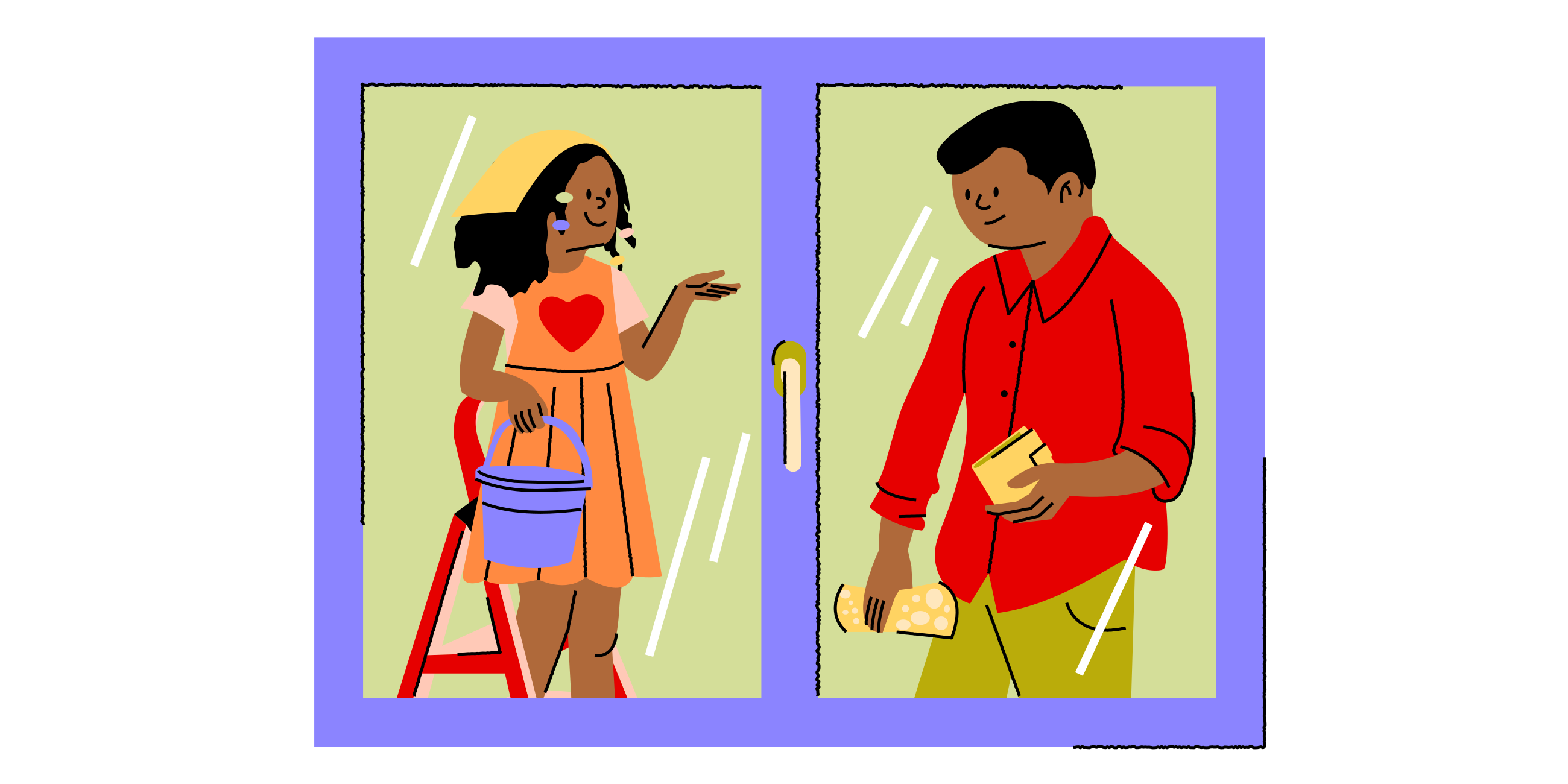
If you want to pay children a small amount for additional tasks, the following model can work: They receive a basic amount of pocket money or a youth wage, which is paid regularly, without being prompted and with no obligations in exchange. On top of this, they also receive a separate bonus if they carry out tasks that are not part of their everyday duties.
Marc: “Well, for 20 francs an hour, your sister would probably say yes, too. Now imagine the dilemma – who do I give the job to? And what happens next? When you start your apprenticeship, you won’t need to help with extra chores at home anymore. Will you just stop helping out around the house? Besides, I don’t want our relationship to be based on money. We should support each other at home voluntarily.”
Samira: “I still think we’d be more willing to help out if we were paid for some of our jobs.”
Have an open discussion beforehand to ensure that your child doesn’t develop the wrong values. This will help your child understand the difference between everyday family duties and additional tasks. Then define for which tasks and under which conditions a bonus will be paid – regardless of the fixed amount of pocket money. This makes the model comprehensible and consistent for your child and contributes to their financial education.
But be careful, because it’s easy to set the wrong incentive if, for example, your child receives 20 francs a month as pocket money and 100 francs for painting the garden fence on a one-off basis.
The ratio between regular pocket money and additional tasks must be right in order to avoid distorting values.

It is also perfectly legitimate if you don’t want to pay your children for helping out around the house. If they ask, explain the reasons. This is also an educational opportunity: they must learn to accept your principles and find their own motivation.
Appreciation can also have a motivating effect. A “Look what you’ve achieved!” also helps your child to gain confidence in their capacities.
If you still want to offer your child a small additional incentive, there are alternatives to payment:
Marc: “Let’s try this instead: we all clean the windows together twice a year, and I pay a contribution into our family fund. Then we can take a trip to the amusement park as a joint reward. Deal?”
Samira: “Hmm ... I can’t buy a skateboard at the amusement park, but I do like riding roller coasters. So if I get to choose the lunch too, I’m in. Deal!”


Make an appointment for a non-binding consultation or if you have any questions, just give us a call.
Disclaimer
This publication is for personal information purposes only within Switzerland and is not to be understood as a recommendation, offer or solicitation of an offer for investment or other specific products and services. It is not intended to form investment, legal or tax advice and should not be used as the basis for financial decisions. Before making a decision, you should obtain professional advice.
All the information and opinions contained in this publication come from reliable and trustworthy sources. Nonetheless, UBS does not accept any contractual or implied liability for any incorrect or incomplete information. The views of non-UBS authors are their own opinions and do not necessarily reflect the views of UBS AG and its affiliates. Complete or partial reproduction without the express consent of UBS is not permitted.
© UBS 1998 - 2026. All rights reserved. The key symbol and UBS are among the registered and unregistered trademarks of UBS.