We’re here for you
Call us or subscribe to our newsletter for in-depth knowledge and current trends.

header.search.error
Warrants allow you to participate disproportionately in the performance of an underlying asset with just a small investment.

Contents:

Warrants are securitized financial products that give the holder the right, but not the obligation, to buy (call warrant) or sell (put warrant) a certain underlying asset either:
at a predetermined price (strike).
Attribute | Description |
|---|---|
Leverage | With a small capital investment, you can participate disproportionately in the performance of the underlying asset. |
Free choice of direction | Depending on the expected market trend, you can bet on rising prices (call warrant) or falling prices (put warrant). |
Diverse options | Equities, indices, currency pairs, interest rates or commodities, for example, can function as underlying assets. |
Flexible trading | Warrants can be traded every trading day and offer high liquidity. |
Hedging | Put warrants allow portfolios or individual positions to be hedged against price losses. |
Volatility factor | Changes in the implied volatility of the underlying asset have a direct impact on the value of a warrant. |
Increased risk | The lever can also work in the opposite direction, which leads to an increased risk of loss, but the maximum loss is limited to the invested capital. |
Characteristic | Description |
|---|---|
Underlying asset | The underlying asset is the reference value of a warrant and significantly influences its price behavior. Examples of underlying assets are equities, indices, currency pairs, interest rates or commodities. |
Strike | The strike (strike price) is the price at which the warrant holder can buy or sell the underlying asset. If the underlying asset is above the strike, a call warrant is in the money and a put warrant is out of the money – and vice versa. If the underlying asset corresponds to the strike, warrants are at the money. |
Conversion ratio | The conversion ratio indicates how many warrants are required to purchase one unit of the underlying asset. With a ratio of 10:1, for example, 10 warrants are required to buy one unit of the underlying asset at the strike. |
Expiry | Warrants have a predetermined lifespan and remain valid only until their specified expiration date (Expiration Day). |
Exercise type | A European-style warrant can only be exercised at the end of the term, whereas the American style can be exercised at any time during the term. |
Repayment | On expiry, warrants are repaid by cash settlement or by delivery of the underlying asset. |
The price of a warrant is made up of the time value and the intrinsic value.
Starting point: An investor expects the Bull AG equity to rise in the coming months. He buys 100 call warrrants at CHF 8 each.
Total stake: CHF 800 (without fees)
Current price of the Bull equity: CHF 100
Features of the call warrant:
Total stake: CHF 800 (100 call warrants at CHF 8 each; excluding fees)
Example scenarios at expiry | Scenario 1 | Scenario 2 | Scenario 3 |
|---|---|---|---|
Price of Bull shares | 110 CHF | 100 CHF | 90 CHF |
Value of Call Warrant | 15 CHF | 5CHF | 0 CHF |
+/- Call-Warrant | +87,50% | -37,50% | -100% |
+/- Bull shares | +10% | +/- 0% | -10% |
This shows that, when prices fall, call warrants make disproportionately high losses. In the worst case (the warrant is out of the money on expiry), a total loss occurs.
Starting point: An investor expects the Bear AG equity to fall in the coming months. He buys 200 put warrants at CHF 6 each.
Current price of the Bear equity: CHF 80
Features of the put warrant:
Total stake: CHF 1200 (200 put warrants at CHF 6 each, without fees)
Example scenarios at expiry | Scenario 1 | Scenario 2 | Scenario 3 |
|---|---|---|---|
Price of Bull shares | 72 CHF | 80 CHF | 88 CHF |
Value of Put Warrant | 12 CHF | 4 CHF | 0 CHF |
+/- Put Warrant | +100% | -33,3% | -100% |
+/- Bear shares | +10% | +/- 0% | -10% |
This shows that with warrants – whether call or put – the disproportionately high profit opportunities are always accompanied by correspondingly increased risks of loss.
Put warrants are not only used for trading, but also for hedging portfolios or individual positions against price losses.
The price of a warrant is not a constant, but changes during its term. While the intrinsic value is influenced by price movements in the underlying asset, two influencing factors in particular affect the time value:
In addition to the residual term to maturity and implied volatility, interest rate levels and dividend expectations also influence the time value of warrants:
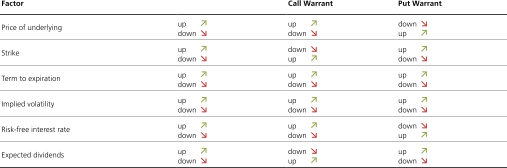
A sharp fall in the price of the underlying asset usually increases implied volatility. A put warrant benefits twice over: its intrinsic value increases and the time value also increases.
Conversely, a put warrant loses both intrinsic value and time value if volatility falls, for example if prices stagnate or rise slightly.
Not all warrants are the same. Repayment can be made either by cash settlement or by delivery of the underlying asset. With regard to the exercise type, a distinction must be made between an American and a European option type.
Warrants are classic leverage products. They enable investors to bet on rising or falling prices with little money. This means you can achieve a big impact with a small stake.
Warrants can also be used to protect your own portfolio against price losses. They therefore not only offer opportunities, but also options for hedging.
However, warrants are not suitable for everyone. You need a good understanding of the markets and should have precise knowledge of the risks. If you are familiar with these products, you can use them in a targeted manner as a tactical investment.
Call us or subscribe to our newsletter for in-depth knowledge and current trends.
Disclaimer
We’ll send you analyses before the market opens, weekly investment ideas and the most important trends on the financial markets.