We’re here for you
Call us or subscribe to our newsletter for in-depth knowledge and current trends.

header.search.error
Climate protection and energy security: investors can profit from investments in renewable energies

At the World Climate Conference (COP 21) in Paris in 2015, the international community agreed on a target that is binding under international law: by the end of the century, global warming is to be limited to well below 2 degrees Celsius compared to the pre-industrial age. At the same time, the aim is to keep the temperature rise below 1.5 degrees Celsius if possible. Reducing greenhouse gas emissions plays a key role in achieving this.
The generation of heat and electricity from fossil fuels is considered one of the biggest emitters of greenhouse gases. In order to achieve a real turnaround here, in addition to more efficient energy consumption, the increased use of renewable energy sources is particularly necessary.
According to figures from the International Renewable Energy Agency (IRENA), renewable energy sources with a capacity of 4.4 terawatts (TW) were installed worldwide at the end of 2024. This means that "renewables" accounted for 46.2% of total global electricity generation capacity. For comparison: in 2000, their share was around one fifth.
The International Energy Agency (IEA) assigns the production of green energy technologies, the development of corresponding electricity production, including battery storage, as well as the trade in electric vehicles and heat pumps to the "Clean Energy" sector. In 2023, these three segments contributed around USD 320 billion to global economic output. One tenth of world growth came from this area.
36.2 million people were employed in this up-and-coming sector in 2023. For comparison: there were 32.1 million jobs in the fossil fuel sector.
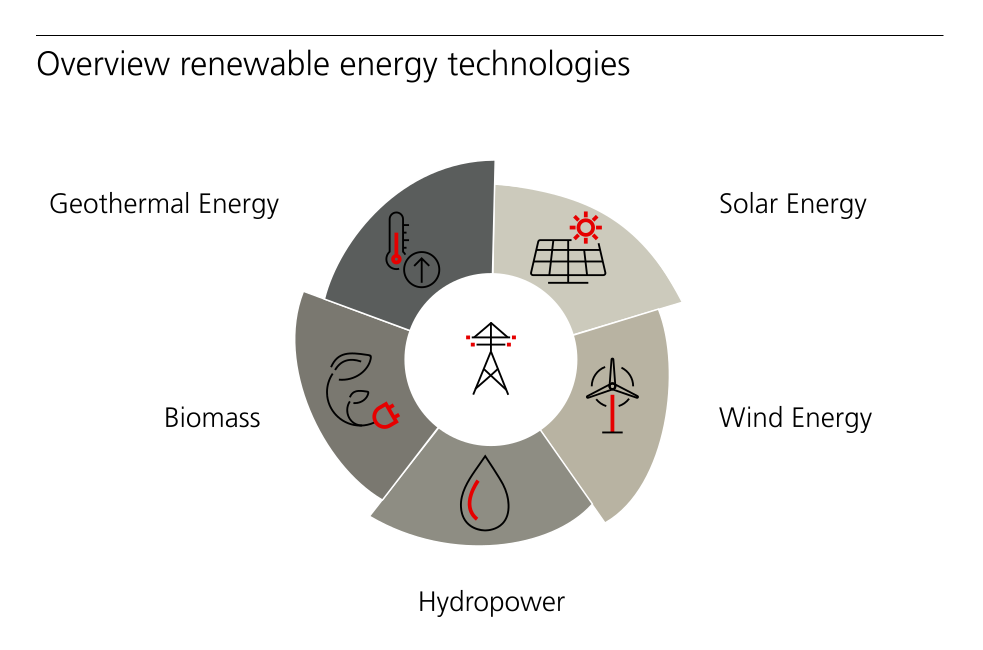
Renewable energy has long been competitive. According to a study by IRENA, 91% of the large-scale renewable energy power plants commissioned in 2024 supplied electricity at a lower cost price than the cheapest, newly installed fossil-fuel power plants. With the help of wind, solar and hydroelectric power plants, countries that have long been dependent on the supply of fossil fuels can build up an independent supply.
Development of electricity generation costs by energy source
Cost of electricity generation when evened out (in USD per kWh)
| Renewable energy technologies | 2010 | 2024 | Change |
|---|---|---|---|
Hydropower | 0.044 | 0.057 | +30% |
Solar energy | 0.417 | 0.043 | -90% |
Onshore wind power | 0.113 | 0.034 | -70% |
Offshore wind power | 0.208 | 0.079 | -62% |
Biomass | 0.086 | 0.087 | +1% |
Geothermal energy | 0.055 | 0.060 | +9% |
Despite the rapid expansion of renewable energies, a faster pace is needed to achieve the target of 1.5 degrees. According to IRENA, capacities must increase to over 11 TW by 2030 – around 2.5 times as much as in 2024.
Investors can invest in individual stocks such as wind turbine manufacturers, green electricity suppliers or PV specialists. Alternatively, capital can be invested in green bonds that finance wind farms, for example.
In addition to actively managed funds, ETFs and structured products are also picking up on this megatrend. One example is the Solactive Renewable Energy Index, which comprises over 40 international companies from the wind energy, solar energy, renewable energy technology and green utilities sectors.
Thanks to its mountains and rivers, Switzerland mainly uses hydropower, which supplies around 60% of its electricity. New renewable energies, especially PV systems, are gaining in importance. Symbiosis can be seen in the Valais mountains: in 2019, a floating PV system went into operation at an altitude of 1,810 meters. High-alpine systems also generate a lot of electricity in winter.
The Federal Council has developed the Energy Strategy 2050 to prepare Switzerland for the transformation of the energy markets. This has created a legal framework for the expansion and support of renewable energy sources.
The government has launched two National Research Programs (NRPs) as part of the Energy Strategy 2050. Numerous studies have resulted in possible solutions and recommendations on how Switzerland could proceed with the transformation of its energy supply.
The global energy transition is driving climate and environmental protection and strengthening energy independence. This megatrend offers numerous opportunities for investors, from individual equities and funds to ETFs and certificates. Sustainable investing pays off – economically and ecologically!
Call us or subscribe to our newsletter for in-depth knowledge and current trends.
Disclaimer
This publication is intended for marketing purposes only.
This material has been prepared by UBS AG or one of its affiliates (“UBS”). This material is only intended for the distribution permitted under the applicable law. It has not been prepared for the needs of a specific recipient. It is only published for information purposes and does not constitute an offer or an invitation to purchase or sell securities or associated financial instruments (“Instruments”). UBS accepts no liability (either expressly or tacitly) for the completeness or reliability of the information contained in this document, except for the information on UBS AG and its affiliates. The information should not be regarded by the recipients as a substitute for their own judgment. All the opinions contained herein may change without prior notice and contradict the opinions of other business areas of UBS due to the application of different assumptions and criteria. UBS is not obliged to keep the information up to date. UBS, its executives, employees or clients may have or have had a participation in the Instruments and may conclude transactions with them at any time. UBS may maintain or have maintained a relationship with the entities specified in this information. Neither UBS nor its affiliates, executives or employees are liable for losses resulting from the use of this information. Structured derivatives do not constitute participation in collective investment schemes. For this reason they do not require approval from the Swiss Financial Market Supervisory Authority (FINMA). As a result, investors are not entitled to the specific investor protection provided by the Swiss Collective Investment Schemes Act (CISA).
Structured products are complex and involve a high risk. The intrinsic value of the investment instruments depends not only on the performance of the underlying asset, but also on the issuer’s creditworthiness (credit risk), which can change over the duration of the product. In relation to any securities, currencies, financial instruments or other assets underlying a transaction to which this material relates, the values may fall as well as rise and past performance is not an indication of future performance. Before entering into any transaction, you should consult your own legal, supervisory, tax, financial and accounting advisors as you consider necessary. You should also make your own investment, hedging and trading decisions (including decisions regarding the suitability of this transaction) at your own discretion and based on your consultation with advisors as you consider necessary. Unless expressly agreed otherwise in writing, UBS does not act as financial advisor or fiduciary in any transaction.
UBS makes no representations or warranties with regard to any information originating from independent sources. This material may not be copied or reproduced without UBS’s prior written permission. Not for distribution in the United States or to US persons.
© UBS 1998 - 2026. All rights reserved. The key symbol and UBS are among the registered and unregistered trademarks of UBS.
UBS prohibits the forwarding of this information without the approval of UBS.
We’ll send you analyses before the market opens, weekly investment ideas and the most important trends on the financial markets.