We’re here for you
Call us or subscribe to our newsletter for in-depth knowledge and current trends.

header.search.error
When physics becomes investing: This new class of computers is reshaping industries and unlocking significant economic potential.

Content:

Quantum computing is considered one of the most important trends of the future - and for good reason: The technology uses the principles of quantum mechanics and can solve computing tasks significantly faster than conventional computers. Instead of bits, qubits are used, which assume several states simultaneously and thus enable enormous parallelization. Especially in conjunction with artificial intelligence, quantum computing opens up new possibilities for solving previously unsolvable problems and holds enormous economic potential. This makes quantum computing an exciting investment opportunity.

This bit is in state 1.

This qubit is simultaneously in state 0, 1 and also in two other states.
Quantum computers use the principles of quantum mechanics and are clearly superior to traditional computers. They work with so-called qubits, which can assume several states simultaneously. This allows many computing processes to be executed in parallel, which increases performance exponentially.
This opens up new possibilities, for example in materials research, chemistry and the life sciences. Quantum computing is regarded as a key technology with great potential: According to McKinsey, the market could be worth up to USD 2 trillion by 2035.
Investments in this area are therefore attractive, but also entail risks. It is still unclear which technologies and algorithms will prevail. Broad diversification is therefore important for investors.
Government subsidies - especially in China, Europe and the USA - as well as increasing private investment show the growing confidence in this technology of the future.
For years, research institutions have been investigating whether quantum computers are scalable and practical to use. Initial results suggest that they could outperform conventional computers, particularly in the research of materials, drugs and protein structures. The technology also offers potential for solving complex optimization problems in areas such as finance and energy, where today's supercomputers fail.

Corrosion causes major damage worldwide. Quantum computers can accurately simulate chemical processes at an atomic level and thus identify more resistant materials. With better quantum computers, industries such as aerospace, energy and infrastructure will benefit from advanced, corrosion-resistant materials.

Quantum computers could significantly accelerate Monte Carlo simulations in the financial sector. Quantum algorithms achieve high accuracy with much less computational effort than traditional computers. For example, complex models for option valuation can be calculated more efficiently and competitive advantages can be achieved.

Quantum computers could revolutionize drug research, as they simulate molecular interactions much more accurately than conventional computers. Laboratory experiments can be shortened, development cycles accelerated and costs reduced. This also makes new therapeutic approaches possible.

Quantum algorithms can control energy grids more efficiently, reduce costs and losses, and detect maintenance and failures at an early stage. In the aerospace industry, they optimize flight routes, save fuel, costs and time. They also enable advances in fuel technology through precise atomic calculations.
Public funding is crucial for the development of the quantum computing sector. Countries around the world are investing around USD 42 billion in this technology. China, Europe and the USA, which consider quantum computing to be strategically important, are notably involved. China is focusing on ambitious projects such as a national quantum communication network. Europe has provided more than USD 13 billion through the Quantum Flagship program. In the USA, around USD 5 billion have been invested in the National Quantum Initiative since 2019, with further investments planned.
Interest is also growing privately: The global venture capital volume reached around USD 1.4 billion in 2024 - an increase of 123% compared to the previous year. Despite the still small market, this development shows the increasing confidence in the future viability of quantum computing.
Start-up funding (in USD mn, left axis), number of deals (right axis)
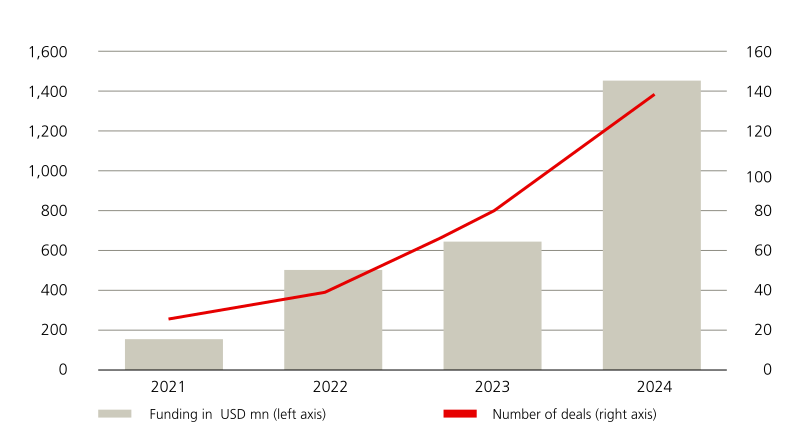
Source: Pitchbook, UBS as of 2025
Note: Not exhaustive
Chart showing the development of quantum computing start-up funding and number of deals.
Diversification is particularly important in young markets such as quantum computing. The megatrend is still in its infancy, and it is unclear when the first groundbreaking applications will be available. Even Nvidia CEO Jensen Huang estimates that practical quantum computers may not become a reality for another 15 to 30 years.
The Global Quantum Leaders Index comprises 30 companies that are at the forefront of the quantum revolution. Only companies that are either actively working on quantum computer technologies or hold at least five relevant patents are included in the index.
In addition, the companies must have a market capitalization of at least USD 150 million and a sufficient trading volume to ensure liquidity and investability.
In order to avoid cluster risks and ensure a balanced diversification, the weighting of each company is limited to a maximum of 8%.
The composition of the index is reviewed quarterly by MarketVector and continuously adapted to the dynamic development of the quantum computing market.
The UBS Tracker Certificate on the Global Quantum Leaders Index gives investors simple and efficient access to the future of quantum computing.
The certificate enables full participation in the performance of leading quantum companies worldwide, less an annual management fee of 0.50%. It is denominated in Swiss francs, has an unlimited term and automatically reinvests dividends on a net basis.
This enables investors to benefit from the long-term growth potential of the quantum computing sector in a broadly diversified, cost-efficient and convenient manner.
Many companies are driving forward the development of quantum computing, heralding a profound change in numerous industries. The race for technological leadership is in full swing: Both global technology groups and specialized start-ups are positioning themselves specifically to benefit from this wave of innovation. Well-known names such as Alphabet, IBM, Amazon, Nvidia and Microsoft have been investing billions in research, development and infrastructure for years, in order to secure a firm place in this future market at an early stage.
| Company | Development of Quantum Computing |
|---|---|
Alphabet | Google Quantum AI is considered one of the industry's pacesetters. The team around Quantum pioneer Hartmut Neven is not only one of the technological leaders, but also one of the most optimistic. They assume that the first real applications could be ready for the market within five years. Alphabet could benefit from this in particular, as quantum computing power can be seamlessly integrated into the existing cloud infrastructure. |
Amazon | The company is positioning itself in the quantum computing market primarily as an enabler and platform provider. Via Amazon Braket, the Group already enables cloud access to quantum computers from various providers and architectures, including systems from D-Wave, IonQ and others. Amazon is thus creating a central infrastructure that companies and researchers can use to develop and test initial quantum applications. At the same time, AWS is investing in its own research and has taken the first steps towards its own hardware with the “Ocelot” quantum chip. |
D-Wave | D-Wave pursues an application-oriented business model. Founded in 1999, the company develops specialized quantum computers based on quantum annealing, which are used in particular for optimization problems in areas such as logistics, financial modelling, production planning and machine learning. D-Wave offers its systems as “Quantum-as-a-Service” via the Leap cloud platform. |
IBM | The US group develops its own quantum hardware based on superconducting qubits, makes it available worldwide in the cloud via IBM Quantum, and combines it with software, development environments and consulting services. Big Blue generates revenue through subscriptions, cloud access, research collaborations and industrial projects in areas such as chemistry, materials research, financial services and logistics. The aim is to gradually integrate quantum computing into existing company processes and establish itself as a leading provider of industrial quantum applications. |
IonQ | IonQ pursues a business model that is clearly focused on cloud-based hardware usage. The company develops quantum computers based on ion trap technology, which is considered to be particularly precise and scalable, and makes them available via leading cloud platforms such as Amazon Web Services, Microsoft Azure and Google Cloud. The aim is to provide marketable quantum computing power at an early stage and to establish itself as a leading provider of commercial quantum services. |
Microsoft | Via Azure Quantum, Microsoft offers companies and research institutions centralized cloud access to various quantum computers from external partners as well as to its own development tools. At the same time, Microsoft is investing in the development of topological qubits, which are considered to be particularly stable and should enable scalable quantum computers in the long term. |
Nvidia | The leading chip manufacturer in the field of AI is not pursuing a classic hardware manufacturer model in the quantum computing sector, but is positioning itself as a central infrastructure and technology partner for the industry. With platforms such as cuQuantum and DGX Quantum, the company supplies the software, computing power and control systems required for simulation and error correction, and the hybrid operation of quantum and high-performance computers. This means that Nvidia will benefit from the growth of the quantum market regardless of which quantum architecture prevails in the long term. |
Rigetti Computing | In quantum computing, Rigetti pursues a vertically integrated business model that combines its own hardware, software and cloud services. The company develops quantum processors based on superconducting qubits and makes them available to clients from industry, research and the financial sector via its Rigetti Quantum Cloud Services. The aim is to establish itself as a specialized provider of scalable quantum hardware and to participate in practical applications in the corporate environment at an early stage. |
Quantum computing is still in its infancy, but the potential is enormous: The technology could fundamentally change computing power and enable new solutions in many key industries. Market forecasts, government subsidies and growing private investment show that quantum computing has long been a strategic market of the future.
Despite technical hurdles and long development cycles, this early phase in particular offers attractive opportunities for long-term investors. Quantum computing is not a short-term yield topic, but a structural growth area that requires patience and diversification.
A broadly diversified approach - for example via the MarketVector™ Global Quantum Leaders Index and the UBS Tracker Certificate based on it - enables transparent and cost-efficient participation in leading companies in the sector. This enables investors to benefit from the growth potential of the quantum computing sector in a targeted and balanced manner.
Call us or subscribe to our newsletter for in-depth knowledge and current trends.
Disclaimer
This publication is intended for marketing purposes only.
This material has been prepared by UBS AG or one of its affiliates (“UBS”). This material is only intended for the distribution permitted under the applicable law. It has not been prepared for the needs of a specific recipient. It is only published for information purposes and does not constitute an offer or an invitation to purchase or sell securities or associated financial instruments (“Instruments”). UBS accepts no liability (either expressly or tacitly) for the completeness or reliability of the information contained in this document, except for the information on UBS AG and its affiliates. The information should not be regarded by the recipients as a substitute for their own judgment. All the opinions contained herein may change without prior notice and contradict the opinions of other business areas of UBS due to the application of different assumptions and criteria. UBS is not obliged to keep the information up to date. UBS, its executives, employees or clients may have or have had a participation in the Instruments and may conclude transactions with them at any time. UBS may maintain or have maintained a relationship with the entities specified in this information. Neither UBS nor its affiliates, executives or employees are liable for losses resulting from the use of this information. Structured derivatives do not constitute participation in collective investment schemes. For this reason they do not require approval from the Swiss Financial Market Supervisory Authority (FINMA). As a result, investors are not entitled to the specific investor protection provided by the Swiss Collective Investment Schemes Act (CISA).
Structured products are complex and involve a high risk. The intrinsic value of the investment instruments depends not only on the performance of the underlying asset, but also on the issuer’s creditworthiness (credit risk), which can change over the duration of the product. In relation to any securities, currencies, financial instruments or other assets underlying a transaction to which this material relates, the values may fall as well as rise and past performance is not an indication of future performance. Before entering into any transaction, you should consult your own legal, supervisory, tax, financial and accounting advisors as you consider necessary. You should also make your own investment, hedging and trading decisions (including decisions regarding the suitability of this transaction) at your own discretion and based on your consultation with advisors as you consider necessary. Unless expressly agreed otherwise in writing, UBS does not act as financial advisor or fiduciary in any transaction.
UBS makes no representations or warranties with regard to any information originating from independent sources. This material may not be copied or reproduced without UBS’s prior written permission. Not for distribution in the United States or to US persons.
© UBS 1998 - 2026. All rights reserved. The key symbol and UBS are among the registered and unregistered trademarks of UBS.
UBS prohibits the forwarding of this information without the approval of UBS.
We’ll send you analyses before the market opens, weekly investment ideas and the most important trends on the financial markets.