
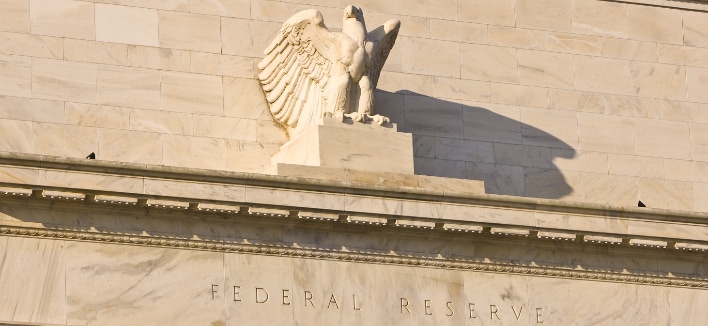
The Fed is likely to hold rates steady in the near term.
- The Federal Reserve left interest rates unchanged at 3.50-3.75% in March, with Chair Jerome Powell stressing that officials would need to see more progress in moderating inflation in the US to ease further.
- The US central bank also raised its inflation and GDP growth projections for 2026.
- Powell added that it was too soon to know the scope and duration of the Iran war's potential effects on the economy.
But we think the Fed’s policy easing bias remains intact.
- We expect slowing core goods inflation in the US in the second half of the year to help clear the path for the next cut.
- Growth is likely to downshift to a near trend pace amid higher oil prices.
- While the US's March jobs report beat headline expectations on favorable weather and temporary factors, we believe easing will most likely be pushed to September–December.
Lower interest rates strengthen the case for investors to put excess cash to work.
- Investors should consider phasing excess liquidity into diversified portfolios.
- To achieve alternative sources of portfolio income to cash, we identify short- to medium-maturity quality bonds and equity income strategies as appealing.
New this week
US consumer price inflation for March, released on 10 April, rose 0.87%, posting the largest monthly price gain since June 2022. The conflict in the Middle East drove a 21.2% month-over-month rise in gasoline, the biggest monthly increase ever recorded in data since 1967. Core CPI, a measure more closely watched by the Federal Reserve, stood at 3.3% year-over-year a near-two-year high.
Did you know?
- Analysis by the Dallas Fed shows that the incremental price pressure due to rises in energy prices tends to fade quickly after a few months, with core inflation little changed.
- We think bond markets are currently too focused on the short-term inflationary impact of higher energy prices, and not enough on the potential medium-term negative growth impact which could drive interest rate cuts, nor on the potential for de-escalation.
- Powell has explicitly argued that monetary tightening is often the wrong response to a supply shock. “By the time the effects of a tightening in monetary policy take effect, the oil price shock is probably long gone, and you’re weighing on the economy at a time when it’s not appropriate."
- Cash tends to underperform other assets over time: Stocks have outperformed cash in 86% of all 10-year periods and 100% of all 20-year periods since 1926.
Investment view
Lower interest rates reduce potential returns on cash. Investors can consider phasing excess liquidity into diversified portfolios. We also like short- and mediium-maturity quality bonds, which can offer a more durable source of income.
