We’re here for you
Call us or subscribe to our newsletter for in-depth knowledge and current trends.

header.search.error
Leverage effect of mini futures: Benefit & function
With mini futures, you can bet on rising or falling prices of an underlying asset. The leverage results from the reduced capital investment.

Mini futures are derivative leverage products that enable investors to participate disproportionately in rising (long) or falling (short) prices of an underlying asset. They offer transparency, flexibility and a wide range of possibilities. Pricing is based directly on the underlying asset, which ensures transparency. Thanks to the large number of possible underlying assets, such as shares, indices, commodities or currencies, they can be used in a variety of ways. In addition, mini futures can be traded on each trading day under normal market conditions.
Mini futures at a glance
As one of the leading providers of mini futures, UBS KeyInvest offers you a wide range of products on various asset classes and underlying assets.
The way mini futures work is based on two central features: The financing level and the stop loss.
Financing level: Investors invest in an underlying asset at a fraction of the price, while the rest is provided by the issuer. This leads to a leverage effect, as the mini future participates fully in the price movements of the underlying asset.
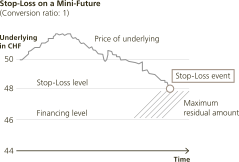
Stop loss level: Mini futures have no fixed expiration date and can theoretically run indefinitely. However, they have a loss limit. If the underlying asset reaches the stop loss, the mini future expires automatically. The issuer then calculates the residual value and, if it is above zero, pays this to the investor.
With mini futures, a clear idea of the performance of the underlying asset is crucial. Investors who bet on rising prices buy long mini futures, which participate disproportionately in price gains. Higher leverage increases the chances of profit, but also the risk of disproportionate losses when prices fall.
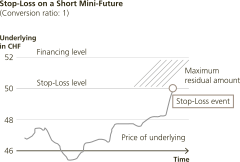
The value of a short mini future rises when the underlying asset falls, and falls when the underlying asset rises. They are bought in anticipation of falling prices and can be used to hedge a portfolio.
An investment in a mini future is similar to a direct investment in the underlying asset. If the underlying asset, for example a share, rises by CHF 1, a long mini future – with a subscription ratio of 1 – also rises by CHF 1. However, the investor only pays a fraction of the price of the underlying asset; the issuer finances the rest. This leads to a leverage effect: The higher the financing share of the issuer, the greater the leverage.
It is important to carefully weigh up the opportunities and risks of leverage.

The closer the financing level (and the stop loss) is to the current price of the underlying asset, the greater the leverage effect of a mini future. However, this also increases the risk that even small price movements will trigger a stop loss event and lead to losses. It is therefore important to carefully weigh up the leverage opportunities against the stop loss risk.
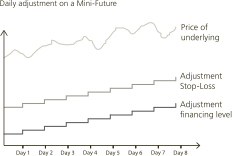
Anyone who provides outside capital expects an appropriate return, and this also applies to mini futures. The issuer therefore charges financing costs, which consist of a reference interest rate (e.g. SARON for CHF or SOFR for USD) plus a financing spread. The spread may vary and is specified in the product term sheet.
Short mini futures are an efficient and cost-effective instrument for hedging a portfolio or certain portfolio components such as index investments. Here is an example:
This simple type of hedging makes sense even over short periods of time.
Mini futures offer a flexible way to respond to market movements or hedge a portfolio. When used correctly, the leverage effect can generate disproportionately high profits. A solid understanding of market risks and careful analysis is essential.
Call us or subscribe to our newsletter for in-depth knowledge and current trends.
Disclaimer
This publication is intended for marketing purposes only.
This material has been prepared by UBS AG or one of its affiliates (“UBS”). This material is only intended for the distribution permitted under the applicable law. It has not been prepared for the needs of a specific recipient. It is only published for information purposes and does not constitute an offer or an invitation to purchase or sell securities or associated financial instruments (“Instruments”). UBS accepts no liability (either expressly or tacitly) for the completeness or reliability of the information contained in this document, except for the information on UBS AG and its affiliates. The information should not be regarded by the recipients as a substitute for their own judgment. All the opinions contained herein may change without prior notice and contradict the opinions of other business areas of UBS due to the application of different assumptions and criteria. UBS is not obliged to keep the information up to date. UBS, its executives, employees or clients may have or have had a participation in the Instruments and may conclude transactions with them at any time. UBS may maintain or have maintained a relationship with the entities specified in this information. Neither UBS nor its affiliates, executives or employees are liable for losses resulting from the use of this information. Structured derivatives do not constitute participation in collective investment schemes. For this reason they do not require approval from the Swiss Financial Market Supervisory Authority (FINMA). As a result, investors are not entitled to the specific investor protection provided by the Swiss Collective Investment Schemes Act (CISA).
Structured products are complex and involve a high risk. The intrinsic value of the investment instruments depends not only on the performance of the underlying asset, but also on the issuer’s creditworthiness (credit risk), which can change over the duration of the product. In relation to any securities, currencies, financial instruments or other assets underlying a transaction to which this material relates, the values may fall as well as rise and past performance is not an indication of future performance. Before entering into any transaction, you should consult your own legal, supervisory, tax, financial and accounting advisors as you consider necessary. You should also make your own investment, hedging and trading decisions (including decisions regarding the suitability of this transaction) at your own discretion and based on your consultation with advisors as you consider necessary. Unless expressly agreed otherwise in writing, UBS does not act as financial advisor or fiduciary in any transaction.
UBS makes no representations or warranties with regard to any information originating from independent sources. This material may not be copied or reproduced without UBS’s prior written permission. Not for distribution in the United States or to US persons.
© UBS 1998 - 2026. All rights reserved. The key symbol and UBS are among the registered and unregistered trademarks of UBS.
UBS prohibits the forwarding of this information without the approval of UBS.
We’ll send you analyses before the market opens, weekly investment ideas and the most important trends on the financial markets.