

Switzerland is engaged in an important regulation debate about banking stability that will shape the future of the Swiss financial center for years to come. UBS has consistently emphasized the importance of drawing the right lessons from the Credit Suisse crisis and supports the objective of further strengthening the resilience of the financial system.
As a major company, Switzerland’s third-largest private employer and a significant lender to Swiss households and companies, UBS is committed to actively contributing its position to the debate. On this page you find various content on this matter, including media releases, position papers and consultation responses.
UBS remains committed to its globally diversified business model and unique regional footprint. As the largest truly global wealth manager and leading bank in Switzerland, with competitive global investment bank and asset management capabilities, we bring financial stability, expertise, economic benefits and international know-how to our home market Switzerland and our clients globally.
The Swiss financial center is once again at a critical juncture, where the course for the coming decades will be set. UBS will continue to contribute facts and analysis to support an informed discussion and a regulatory outcome that strikes the right balance between financial stability and Switzerland’s ability to remain competitive and grow. We want to ensure that UBS can continue to serve its clients in Switzerland and globally from a position of strength, connecting them to opportunities, expertise and markets around the world. This allows us to further strengthen our resilience and create value for all our stakeholders, including shareholders, clients and employees.
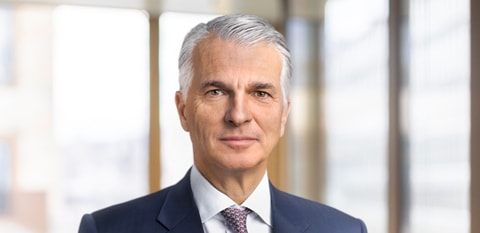
Sergio P. Ermotti
UBS Group CEO
UBS media releases and statements

| Date | UBS media releases and statements | Link |
|---|---|---|
1 September 2026 | UBS statement on WAK-S recommendation on banking regulation | |
12 August 2026 | UBS statement on the consultation launch by the Swiss Federal Council:
| - |
22 April 2026 | UBS statement on regulatory capital announcements made by the Swiss government | |
6 June 2025 | UBS statement on regulatory proposals made by the Swiss government |
Position papers
Row toggle | Date | Position papers | Languages |
|---|---|---|---|
21 September 2026 | Swiss TBTF discussion – Key Points for the Debate on the Banking Act | ||
| |||
29 July 2026 | Too big to fail - Facts and figures | ||
| |||
4 February 2026 | The Implications of the Capital Regulation Proposals on Switzerland | ||
| |||
4 February 2026 | The UBS Business Model: Risk-Aware, Broadly Diversified and Stable | ||
| |||
4 February 2026 | UBS Position on Share Buybacks | ||
| |||
4 February 2026 | Impact of Rising Capital Requirements on Capital Costs | ||
| |||
4 February 2026 | UBS Position on the Proposed Amendments to the Capital Adequacy Ordinance | ||
| |||
4 February 2026 | The Swiss Regulatory Proposals in the International Context | ||
|

Consultation responses
Summary
UBS supports the Federal Council's objective of drawing lessons from the Credit Suisse crisis and strengthening the regulatory framework with targeted, proportionate, and internationally aligned measures. However, the proposed full deduction of foreign subsidiaries from Common Equity Tier 1 (CET1) capital extends far beyond the original proposal from 2024 and clearly does not meet these criteria, which is why we clearly reject the proposal. This measure would put UBS at a significant disadvantage internationally, as UBS would have at least 50% higher capital requirements than its competitors in Europe and the US. These excessive capital requirements would lead to very high costs for the bank and weaken the Swiss financial center and the economy.
Switzerland already has one of the strictest regulatory capital regimes, with substantial progressive capital surcharges, and a conservative and early implementation of the final Basel 3 rules. The Federal Council's proposals would significantly increase the requirements and would contrast sharply with developments in Europe and the US, where de-regulation initiatives have already been announced. This would further worsen Switzerland's international competitive position following the early implementation of Basel 3.
Regulatory adjustments should address the lessons learned from the Credit Suisse crisis in a consistent and targeted manner. The Credit Suisse crisis was primarily the result of the bank's unsustainable strategy and insufficient profitability, inadequate risk management, an inappropriate culture, and weak governance. For too long, Credit Suisse was not forced to take corrective action because regulatory concessions tailored to Credit Suisse undermined the regulations that actually applied. This was also noted by the Parliamentary Investigation Commission (PUK), among others.
In its statement of September 29, 2025, on the amendments to the Capital Adequacy Ordinance, UBS explained that the proposed regulatory valuation of software, deferred tax assets, and regulatory valuation adjustments is a combination of the maximum requirements of various jurisdictions and does not take into account the ultimate impact of the overall package in the respective countries. The proposed requirements were also deemed excessive and not internationally aligned in the statements issued by the business community as a whole, employee associations, banks, cantons with strong financial centers, and business-oriented parties. After consulting with the industry and authorities, the Economic Affairs and Taxation Committees (WAK) of both chambers of parliament spoke out in favor of internationally aligned rules.
The Federal Council's proposal on capital requirements for foreign subsidiaries is based on the extreme assumption that the parent bank must be able to absorb the total loss of all of its foreign subsidiaries during ongoing operations without any negative impact on the parent bank's Common Equity Tier 1 (CET1) capital. The proposal extends far beyond the original objective of the Federal Council's report on banking stability dated April 10, 2024. While the report called for 100% Tier 1 coverage, the new proposal calls for approximately 130% Tier 1 coverage. For UBS, this would result in additional CET1 capital requirements of approximately USD 23 billion and thus very high costs, not only for UBS, but for the entire financial center, households, and companies. The Swiss economy would be weakened.
The proposal to protect Switzerland completely from losses incurred by foreign subsidiaries at all times totally ignores the fact that the TBTF package includes further key measures that significantly increase resilience and were not yet available at the time of the Credit Suisse crisis, e.g., the senior manager regime, expanded restructuring and resolution options, the public liquidity backstop, and the expanded "lender of last resort" function. Furthermore, it does not take into account that Credit Suisse benefited from substantial regulatory relief, so that Credit Suisse's weaknesses were not sufficiently highlighted in official publications, and that UBS operates a balanced and conservative business model compared to Credit Suisse and other G-SIBs.
Foreign subsidiaries are an integral part of the consolidated parent bank's business model. Completely insulating the parent bank from risks arising from foreign business activities that are booked in subsidiaries contradicts the business model of a global bank or any internationally active company, and constitutes a significant restriction on economic freedom. Such a regulation would also only materially affect UBS. Switzerland should not enact laws that are tailored to a single company. The reforms following the financial crisis required certain banking activities that had previously been carried out in branches to be outsourced to subsidiaries in Europe and the US. However, a global bank is dependent on extensive international links in order to provide customer services, including essential support for the Swiss export industry (e.g., loans and financing, foreign currency hedging, payments).
The Federal Council's proposal would represent a single-handed approach, which would isolate Switzerland internationally. Neither the Basel standards nor competing locations have such extreme requirements. Contrary to the description in the explanatory report, the UK and the EU also have significantly less stringent regulations compared to the Swiss proposal.
The explanatory report identified various alternatives to a full CET1 deduction and assessed them as effective. However, the Federal Council has rejected these because they do not meet the extreme objective of zero risk tolerance. The proposal aims to cover extreme crisis scenarios in ongoing business operations. However, systemically important banks develop comprehensive recovery and resolution plans for such scenarios, which are approved by FINMA. In addition, banks must hold substantial incremental Tier 1 in the form of AT1 and convertible debt.
The lessons learned from the Credit Suisse crisis have shown that, on the one hand, existing regulations must be consistently implemented and, on the other hand, subsidiaries must be valued conservatively and without a regulatory filter. This would have made Credit Suisse's parent bank substantially more resilient.
There are significant differences in the cost estimates. The study authored by Prof. Zimmermann in April 2025 shows unrealistically low cost implications. The market estimates the costs to be several times higher than the study. It is our investors and counterparties who determine the cost of capital for UBS and, as a result, for our clients, and these differ considerably from academic findings. The large difference is mainly due to the fact that, in the opinion of the relevant market participants, more equity capital does not lead to lower borrowing costs. We also see that the major rating agencies consider the proposed rules to be potentially positive for creditworthiness, but express concerns about their impact on UBS's cost of capital, competitiveness, and business model. These considerations are consistent with those of financial analysts.
Since the publication of the Federal Council report in April 2024, uncertainty surrounding potentially excessive capital requirements has caused UBS's market valuation to underperform banks in Europe and the US by 27% (approximately CHF 30 billion) through the end of December 2025. For UBS shareholders, this represents a significant destruction of value in addition to the costs of integrating Credit Suisse (approx. USD 14 billion). The partial recovery of the share price in recent weeks due to early December speculation about a possible compromise confirms the relevance of regulation for valuation. However, market participants remain concerned that, although UBS would report very high capital under the proposed regulation, it would not be able to use that capital productively and would therefore lose a great deal of competitiveness.
The material additional costs resulting from the proposal would also place a heavy burden on the Swiss economy, as UBS would have to partially offset the additional costs by increasing prices for loans and services in Switzerland. The Federal Council's argument that UBS would only raise prices abroad fails to take into account that the requirements would be imposed in Switzerland and that UBS would therefore also have to hold the excess capital in its parent bank domiciled in Switzerland. This would happen in an increasingly difficult credit environment with higher refinancing costs. Global economic challenges have also led both the US and the UK to recognize that banking regulation has gone too far and to announce significant capital relief measures in order to provide the economy with additional credit.
The SNB confirms that banks' refinancing costs in the financial market have risen and are having an impact on lending. It mentions that the costs on the Swiss financing market may reflect an adjustment in UBS's risk assessment of loans to former Credit Suisse clients, which is confirmed by UBS analyses. The SNB also points out that stricter regulation is already contributing to higher refinancing costs in the domestic market. Global banks with access to international capital markets, such as UBS, can use their more diversified refinancing sources in such a market environment to help avoid a credit crunch in the Swiss market, even in a difficult economic environment.
The economic impact should be assessed through a thorough regulatory impact assessment before far-reaching decisions are made. According to the authors’ assessment, the BSS study published by the Federal Council does not meet this requirement. The responses to the consultation on the Capital Adequacy Ordinance show that fears of negative effects across the entire economy are widely shared.
Conclusion: UBS rejects the full deduction of foreign subsidiaries from CET1 capital, as this would be disproportionate, not internationally aligned, and not targeted. Furthermore, the lessons learned from the Credit Suisse crisis would not be adequately taken into account. The proposal would lead to significant additional costs and jeopardize the continuation of the successful UBS business model. The existing regime, if applied consistently, would have forced Credit Suisse to make structural adjustments much earlier in order to ensure the company's survival.
Summary
UBS supports the Federal Council's objective of learning the lessons from the Credit Suisse crisis and strengthening the regulatory framework with targeted, proportionate and internationally aligned measures. However, the currently proposed capital measures do not meet these criteria. They would put UBS at a significant disadvantage in an international comparison, weaken the Swiss economy and the financial center, and take insufficient account of the lessons learned from the Credit Suisse crisis.
UBS Statement on the Proposed Adjustments to the TBTF Framework
- Switzerland already has one of the toughest, if not the strictest, regulatory capital regimes in the world.
- UBS supports the strengthening of financial stability in principle, provided that implementation is targeted, proportionate and internationally aligned.
- Contrary to the statements of the authorities, there is no overall package. The Federal Council has not sufficiently taken into account the concerns of the experts it has commissioned itself, has not prepared a cost-benefit analysis (including in the submission of 26 September 2025) and has not duly examined alternatives.
- UBS objects to the extreme capital measures because they are neither proportionate nor internationally aligned and do not adequately take into account the lessons of the Credit Suisse crisis, including the role of the substantial capital relief that had been granted over many years.
- As a result of the Credit Suisse takeover initiated by the authorities and the proposed adjustments, UBS would have to hold around USD 42 billion of additional capital, which would make the de facto minimum capital requirement around 50% higher than in the EU, UK and USA.
- The costs of the far-reaching measures would significantly weaken UBS's competitiveness nationally and internationally and would impose considerable additional costs on the Swiss economy in an already difficult environment.
- There are other, internationally established regulations that would have at least equivalent effect, strengthen resilience in the long term and would not incur disproportionate costs for UBS and the economy.
Further resources
Study by BAK Economics
The study by the Swiss economic research institute BAK Economics (BAK), which was commissioned by UBS and published on 16 April 2026, contributes to the ongoing discussion regarding the full deduction of foreign subsidiaries from Common Equity Tier 1 (CET1) capital. For the first time, the economic impacts are quantified. UBS defined the scope of the study, while BAK was solely responsible for its scientific execution.
BAK Economics Study
Summary and key elements
The study shows that the proposed regulatory change would lead to higher borrowing costs, a tighter credit supply and a potential erosion of Switzerland’s appeal as a wealth management hub. The negative economic effects of a single regulatory measure would result in a permanent impairment of Switzerland’s economic performance. The study estimates cumulative losses in value added over a ten-year period of up to CHF 34 billion. This is on the same order of magnitude as the costs of the planned expansion of the armed forces. After ten years, the losses would amount to up to one-third of the projected annual growth in economic output.
BAK states that this development would affect not only value added but also Switzerland’s labor market and public finances: Over ten years, more than 6,000 jobs would be at risk; at the same time, the federal government and cantons could expect lower tax revenues of up to CHF 6.4 billion. By way of comparison: Relief Package 27 (EP27) provides for savings of approximately CHF 5.3 billion over the next three years.
Paper by Yvan Lengwiler, Kumar Rishabh, Rolf Watter: Strengthening the recovery capability of Swiss banks
The paper published in June 2026 highlights the role of Additional Tier 1 instruments (“AT1”) in absorbing losses during the stabilization phase and provides proposals for their further development. The publication was commissioned by UBS; however, UBS had no influence on the conclusions.
Paper (published in GesKR; German only)
NZZ guest article by Yvan Lengwiler and Rolf Watter, 17 June 2026
How stable is the Swiss banking system – and what role does UBS play?

Banking is one of the most highly regulated sectors because banks play a key role in the economy and for financial stability. As a consequence of the 2008-2009 global financial crisis, under the aegis of the Basel Committee on Banking Supervision, the requirements, in particular for capital, liquidity and resolvability of systemically important banks, became stricter. Periods of stress and crises can never be entirely ruled out, which is why considerable emphasis is placed on major banks’ resilience and ability to restructure.
As the Swiss National Bank also notes, for banks, profitability is the first and most important pillar of stability. Only a sustainably profitable bank is a safe bank for clients, employees and investors.
Not all banks are structured equally, and significant differences in terms of risks exist. Yet all banks have in common that risk management is a core responsibility.
UBS changed its business model significantly following the financial crisis of 2008, significantly reducing its investment bank activities from more than 70% of balance sheet assets to under 30%. UBS’s core business has long been its market-leading Global Wealth Management business and the Swiss universal bank, supported by a targeted, competitive Investment Bank. The core areas account for roughly 70% of balance sheet assets and generate around 80% of revenues. They remain particularly stable under varying market conditions and, due to their leading position, are also particularly valuable. This unique business model makes the bank highly resilient.
Regarding UBS’s size: the bank is now much smaller than before the financial crisis. UBS and Credit Suisse’s combined balance sheet is now around 60% lower than it was back then. And a large proportion of the balance sheet has little or no risk – for example, cash reserves, government bonds and Swiss mortgage loans.
A crisis can occur at any time and will always differ from the previous one. What would happen if UBS were to be affected by such a crisis?
The second line of defense would come into play: capital and liquidity buffers. Capital, including shareholder capital, can absorb losses, and liquidity is important for banking operations, especially when clients withdraw their deposits in a crisis. The capital buffers have increased massively in relation to the balance sheet since the financial crisis. UBS’s Common Equity Tier 1 (CET1) capital ratio exceeds Swiss requirements, which are already strict by international standards, by around a third. With its CET1 capital alone, UBS could cover Credit Suisse’s 2022 annual loss more than eight times. UBS’s liquidity coverage ratio is among the highest in the world.
In the event of a major crisis, the bank could carry out restructuring. As this area is strictly regulated too, UBS can draw on comprehensive crisis plans with predefined stability measures. The plans are examined and approved annually by FINMA, the Swiss supervisory authority. They include the sale or partial sale of business areas, implementation of liquidity options or an increase in capital. In this way, UBS could withstand a significant crisis with its own resources, also with the use of AT1 capital, with no costs for taxpayers.
Regarding taxes: With their employees, over the last ten years, UBS and Credit Suisse have paid around CHF 2.5 billion per year on average to the fiscal budgets of Swiss municipalities, cantons and the Confederation.
If the above-mentioned stability measures were to prove insufficient, the authorities could initiate a so-called resolution, which would be accompanied by a massive shrinking of the balance sheet and a focus on selected core businesses. Not only to rescue the bank, but to ensure financial stability. Incidentally, this would also have been possible for Credit Suisse, as the Financial Stability Board, the Bank for International Settlements, the Swiss Federal Council’s group of experts on banking stability and FINMA have confirmed.
In such a case, UBS’s equity basis would be strengthened by converting liabilities in the amount of CHF 85 billion. This would make substantial funds available for restructuring – in addition to the more than CHF 80 billion of core capital for ongoing operation. Bonuses would not be paid at this point, shares would be written down and the bank’s management would be replaced.
So, as you can see, UBS is resilient, highly capitalized, risk-aware and has a number of courses of action available in extreme crises. Even in the worst case, savings are protected, essential services are available and the economy is intact.
UBS is a safe bank with a healthy balance sheet and is very well prepared to protect the interests of both clients and taxpayers in all scenarios.
Video with subtitles in German:

Das Bankwesen gehört zu den am strengsten regulierten Branchen, weil Banken eine zentrale Rolle in der Wirtschaft und für die Finanzstabilität haben. Als Folge der globalen Finanzkrise 2008/2009 verschärften sich unter der Führung des Basler Ausschusses für Bankenaufsicht insbesondere die Anforderungen für Kapital, Liquidität und Abwicklungsfähigkeit der systemrelevanten Banken.
Stressphasen und Krisen können nie vollständig ausgeschlossen werden, weshalb ein grosses Augenmerk auf die Widerstands- und Sanierungsfähigkeit von grossen Banken gelegt wird.
Wie auch die Schweizerische Nationalbank festhält, ist Profitabilität für eine Bank der erste und wichtigste Stabilitätspfeiler. Nur eine nachhaltig profitable Bank ist eine sichere Bank für Kunden, Mitarbeitende und Investoren.
Nicht alle Banken sind jedoch gleich aufgestellt. Und damit gibt es auch grosse Unterschiede betreffend Risiken. Für alle Banken gilt aber: Risikomanagement ist eine Kernaufgabe.
UBS hat ihr Geschäftsmodell nach der Finanzkrise 2008 stark verändert und dabei die Investment-Bank-Aktivitäten massiv reduziert von über 70 Prozent der Bilanzaktiven auf nicht einmal 30 Prozent. Das Kerngeschäft von UBS sind längst die marktführende globale Vermögensverwaltung und die Schweizer Universalbank, unterstützt von einer schlanken, wettbewerbsfähigen Investment Bank. Die Kernbereiche machen rund 70 Prozent der Bilanzaktiven aus und generieren rund 80 Prozent der Erträge. Sie sind über verschiedene Marktlagen hinweg besonders stabil und aufgrund ihrer führenden Wettbewerbsposition auch besonders wertvoll. Dieses einzigartige Geschäftsmodell macht die Bank sehr widerstandsfähig.
Zur Grösse von UBS: Die Bank ist heute deutlich kleiner als vor der Finanzkrise. Die kombinierte Bilanz von UBS und Credit Suisse ist rund 60 Prozent kleiner als damals. Und ein grosser Anteil der Bilanz weist keine oder nur geringe Risiken auf, bspw. Barbestände, Staatsanleihen, oder Schweizer Hypotheken.
Krisen kann es immer geben und sie werden anders sein als die letzten. Was passiert, wenn eine solche Krise UBS treffen würde?
Dann käme die zweite Verteidigungslinie zum Zuge: Kapital- und Liquiditäts-Puffer. Kapital, und damit auch die Einlagen der Aktionäre, kann Verluste auffangen und Liquidität ist wichtig für den Betrieb der Bank, gerade auch wenn Kunden in einer Krise Einlagen abziehen.
Die Kapitalpuffer sind seit der Finanzkrise im Verhältnis zur Bilanzgrösse massiv angestiegen. Die sogenannte harte Kernkapitalquote (CET1) von UBS übersteigt die bereits heute im internationalen Vergleich strengen Schweizer Anforderungen um rund ein Drittel. Allein mit ihrem harten Kernkapital könnte UBS den Jahresverlust 2022 der Credit Suisse über acht Mal decken. Und auch die Liquiditätsquote von UBS gehört zu den höchsten weltweit.
Im Falle einer bedeutenden Krise könnte die Bank eine Sanierung vornehmen. Da auch dieser Bereich stringent reguliert ist, kann UBS dafür auf umfassende Krisenpläne mit vordefinierten Stabilisierungsmassnahmen zurückgreifen. Die Pläne werden jährlich von der Aufsichtsbehörde FINMA geprüft und genehmigt. Sie beinhalten zum Beispiel den Verkauf oder die Teilabwicklung von Geschäftsbereichen, die Nutzung von Liquiditätsoptionen oder eine Kapitalerhöhung. Somit könnte UBS eine erhebliche Krise mit eigenen Mitteln überstehen, auch mit dem Einsatz von AT1-Kapital, ohne Folgekosten für Steuerzahlerinnen und Steuerzahler.
Apropos Steuern: UBS und Credit Suisse haben zusammen mit ihren Mitarbeitenden über die letzten zehn Jahre im Schnitt rund 2,5 Milliarden Franken jährlich zu den Steuerhaushalten von Schweizer Gemeinden, Kantonen und Bund beigetragen.
Falls auch die erwähnten Stabilisierungsmassnahmen nicht genügen sollten, könnten die Behörden in diesem Extremfall eine sogenannte Abwicklung auslösen, die mit einer massiven Schrumpfung der Bilanz und der Fokussierung auf ausgewählte Kerngeschäfte einhergehen würde. Nicht nur um die Bank zu retten, sondern um die Finanzstabilität sicherzustellen. Dies wäre übrigens auch bei der Credit Suisse möglich gewesen, wie das Financial Stability Board, die Bank für internationalen Zahlungsausgleich sowie die Expertengruppe Bankenstabilität des Bundesrates und die FINMA bestätigt haben.
Die Eigenkapitalbasis der Bank würde mittels einer Wandlung von Fremdkapital in der Grössenordnung von 85 Milliarden Franken gestärkt. Damit stünden erhebliche Mittel für eine Restrukturierung bereit – und dies zusätzlich zu den über 80 Milliarden Franken Kernkapital für den laufenden Betrieb. Boni würden an dieser Stelle gestrichen, Aktien abgeschrieben und die Bankleitung ausgewechselt.
Wir sehen: UBS ist widerstandsfähig, stark kapitalisiert, risikobewusst und hätte auch in extremen Krisen diverse Handlungsmöglichkeiten. Auch im Extremfall sind Ersparnisse geschützt, grundlegende Dienstleistungen verfügbar und die Wirtschaft intakt.
UBS ist eine sichere Bank mit einer gesunden Bilanz und sehr gut vorbereitet, um die Interessen der Kundinnen und Kunden sowie Steuerzahlerinnen und Steuerzahler in allen Szenarien zu schützen.
Video with subtitles in French:

Le système bancaire est l’une des branches les plus réglementées car les banques jouent un rôle essentiel dans l’économie et pour la stabilité financière. Après la crise financière mondiale de 2008/2009, les exigences relatives aux fonds propres, aux liquidités et à la capacité de liquidation des banques d’importance systémique ont été renforcées sous l’impulsion du Comité de Bâle sur le contrôle bancaire. Comme les épisodes de tension et les crises ne pourront jamais être totalement exclus, une attention particulière est portée à la capacité de résilience et d’assainissement des grandes banques.
La Banque Nationale suisse souligne aussi que la rentabilité est le premier et le plus important pilier pour la stabilité d’une banque. Seule une banque qui génère des bénéfices de manière régulière est une banque sûre pour sa clientèle, pour son personnel et pour les investisseurs.
Cependant, toutes les banques n’ont pas le même profile d’activité, de sorte qu’il existe également d’importantes différences en matière de risques. Toutefois, une règle s’applique à toutes les banques : la gestion des risques est une tâche essentielle.
UBS a fortement modifié son modèle d’affaires après la crise financière de 2008. Ainsi, elle a réduit considérablement les activités de la banque d'investissement, dont la part dans les actifs du bilan est passée de plus de 70% à moins de 30%. Le cœur de métier d’UBS réside depuis longtemps dans la gestion de fortune, dont elle est le leader mondial, et dans la banque universelle suisse, soutenue par une banque d’investissement agile et compétitive.
Ces activités clés représentent environ 70% des actifs du bilan et génèrent environ 80% des revenus. Elles demeurent particulièrement stables, quelles que soient les conditions du marché et, en raison de leur compétitivité, elles génèrent aussi une forte valeur ajoutée. Ce modèle d’affaires unique rend la banque très résiliente.
Concernant la taille d’UBS : la banque est aujourd’hui beaucoup plus petite qu’avant la crise financière. Le bilan combiné d’UBS et du Credit Suisse est environ 60% inférieur à ce qu’il était alors. Et une part importante du bilan ne présente aucun risque ou seulement des risques faibles : p. ex. les liquidités, les emprunts d’Etat ou les hypothèques suisses.
Il y aura toujours des crises et elles seront différentes des précédentes. Que se passerait-il si une telle crise touchait UBS ?
La deuxième ligne de défense entrerait alors en jeu : les volants de fonds propres et de liquidités. Les fonds propres, et donc aussi les dépôts des actionnaires, peuvent compenser les pertes et les liquidités sont essentielles au fonctionnement de la banque, notamment lorsque les clientes et clients retirent leurs dépôts en période de crise. Depuis la crise financière, les volants de fonds propres ont fortement augmenté par rapport à la taille du bilan. Le ratio de fonds propres de base durs (CET1) d’UBS dépasse déjà aujourd’hui les exigences suisses, strictes en comparaison internationale, d’environ un tiers.
Avec ses seuls fonds propres durs de base, UBS aurait pu couvrir plus de huit fois la perte annuelle du Credit Suisse en 2022. Et le ratio de liquidité d’UBS est aussi parmi les plus élevés à l’échelle mondiale.
Dans l’hypothèse d’une crise majeure, la banque pourrait effectuer un assainissement. Comme ce domaine est lui aussi strictement réglementé, UBS peut, à cet effet, recourir à des plans de crise complets qui prévoient des mesures de stabilisation prédéfinies. Les plans sont vérifiés et approuvés annuellement par la FINMA, l’autorité de surveillance. Ils préconisent par exemple la vente ou la liquidation partielle de certaines activités, le recours à des mesures de liquidité ou encore une augmentation de capital. De cette manière, UBS pourrait résister à une crise majeure grâce à ses propres moyens, et également grâce à l’utilisation de capital AT1, sans que les contribuables n’aient à en supporter le coût.
Concernant les impôts : au cours des dix dernières années, UBS et le Credit Suisse ont, avec leur personnel, contribué aux recettes fiscales des communes, des cantons et de la Confédération, en moyenne à hauteur de près de 2,5 milliards de francs par an.
Si les mesures de stabilisation mentionnées ne devaient pas suffire, les autorités pourraient, dans des cas extrêmes, déclencher une « liquidation », qui s’accompagnerait d’une réduction massive du bilan et d’une focalisation sur certaines activités clés sélectionnées. Le but ne serait pas seulement de sauver la banque, mais aussi de garantir la stabilité financière. Cela aurait d’ailleurs été possible pour le Credit Suisse, comme l’ont confirmé le Financial Stability Board, la Banque des règlements internationaux, ainsi que le groupe d’experts sur la stabilité bancaire du Conseil fédéral et la FINMA.
Les fonds propres de la banque auraient été renforcés au moyen d’une conversion de capitaux étrangers de l’ordre de 85 milliards de francs. Des moyens financiers considérables auraient ainsi été disponibles pour une restructuration – et ce, en plus des plus de 80 milliards de francs de fonds propres de base destinés à l’exploitation courante.
Les bonus auraient alors été supprimés, la valeur des actions dépréciée et la direction de la banque remplacée.
Ce que nous constatons : UBS est résiliente, solidement capitalisée, consciente des risques et aurait, même en cas de crise extrême, plusieurs possibilités d’action. Même dans une situation extrême, les avoirs seraient protégés, les prestations de services essentiels resteraient disponibles et l’économie demeurerait préservée.
UBS est une banque sûre qui présente un bilan sain. Elle est très bien préparée pour protéger les intérêts de sa clientèle ainsi que des contribuables dans tous les cas de figure.


