Concerns about rising rents and housing costs are growing
In 2026, rising rents and high housing costs are a greater concern in Switzerland than ever before. The UBS Worry Barometer shows what is driving these concerns.

header.search.error
In 2026, rising rents and high housing costs are a greater concern in Switzerland than ever before. The UBS Worry Barometer shows what is driving these concerns.

The UBS Worry Barometer 2026 makes one thing clear: For many people in Switzerland, finding and keeping an affordable home is a major everyday concern. A total of 30% of respondents rank rising rents and higher housing costs among their five biggest concerns, up 6 percentage points year on year.
Higher housing costs and rising rents have therefore moved up to second place in the 2026 ranking of concerns, compared with seventh place the previous year. This means the issue has overtaken other concerns that frequently rank near the top of the Worry Barometer. These include environmental protection and climate change, OASI and retirement provision, and immigration. Only healthcare costs and health insurance premiums are a greater concern for Swiss voters.
Top–5–concerns
Here you can see a list of topics that have been discussed and written about a lot recently. Please read through the list and then select the five that you personally consider to be the five most important problems facing Switzerland.
in % of eligible voters, share of mentions
multiple entries possible
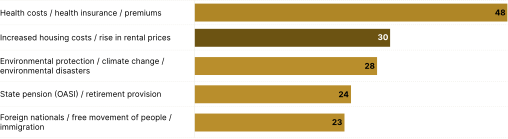
The long-term trend is clear: High housing costs and rising rents have become much more prominent among the concerns of people in Switzerland. In the UBS Worry Barometer 2026, more respondents than ever named housing costs as one of the country’s most important concerns.
The picture of economic concerns has changed significantly over recent decades. While unemployment was one of the dominant concerns, particularly in the 1990s, it has since declined sharply in importance. At the same time, housing costs and rents have become a growing concern, reaching a record 30% in 2026.
Concern about high housing costs and rents is widespread across all age groups. However, the level of concern varies between generations.
For example, 36% of 18- to 39-year-olds say that higher housing costs and rising rents are among their biggest concerns. Among men in this age group, they are even the most frequently mentioned concern, ahead of healthcare costs.
Among 40- to 64-year-olds, the share is slightly lower at 29%. Among those aged over 65, the figure is 26%, 10 percentage points lower than among the youngest respondents.

Given the high cost of housing, it is worth looking beyond the major urban centers. The basic rule is: the more central the location, the higher the cost of housing. Housing is also generally relatively expensive in municipalities with low tax rates. But finding a home outside the major urban centers can significantly reduce the strain on your budget.
In the wider metropolitan areas, you can often find affordable homes combined with a high quality of life and good transport connections. If you want to buy a home, choosing where you live more flexibly can broaden your options. Tenants can also benefit from widening their search radius.
The UBS Residential Attractiveness Indicator 2026 shows how much families with two children who rent their home can save. Just 15 minutes outside the major urban centers, annual living costs, including rent, health insurance premiums and taxes, can be several thousand Swiss francs lower.
Price trends in the Swiss real estate market help explain growing concern about housing costs. This trend is particularly clear for owner-occupied homes: Average prices for owner-occupied homes in Switzerland have risen by 70% since 2010. Household incomes grew by 17% over the same period.
Factors driving real estate prices include persistently low interest rates and strong demand for owner-occupied homes in Switzerland. These factors are also likely to boost real estate prices in 2027. Economists at the UBS Chief Investment Office (CIO) expect prices to rise by a further 3% for condominiums and 2.5% for single-family homes in 2027.
The growing concern about housing costs reflects developments in the real estate market. For many households, the dream of owning a home has become financially out of reach.

Price increases in the rental market have been more moderate than for owner-occupied homes. Average asking rents, which are relevant for new leases, rose by 20% between 2010 and 2026, only slightly more than household incomes. Relief is unlikely in the near term: UBS CIO expects asking rents to rise by 1.5% in 2027.
One reason for further rent increases is the low level of new construction, which is unable to keep pace with rising demand. The situation is particularly challenging for low-income households: the supply of affordable rental apartments is currently much lower than in previous years.
Property prices and rents are also expected to rise in 2027. Concerns about affordable housing are therefore likely to persist.
The UBS Worry Barometer 2026 shows the extent of public concern about housing costs in Switzerland. Rising real estate prices, higher rents and the limited supply of affordable housing are a reality in Switzerland and are likely to remain challenging in the future. Relief is unlikely in the near term.
Disclaimer
This publication is for personal information purposes only within Switzerland and is not to be understood as a recommendation, offer or solicitation of an offer for investment or other specific products and services. It is not intended to form investment, legal or tax advice and should not be used as the basis for financial decisions. Before making a decision, you should obtain professional advice.
All the information and opinions contained in this publication come from reliable and trustworthy sources. Nonetheless, UBS does not accept any contractual or implied liability for any incorrect or incomplete information. The views of non-UBS authors are their own opinions and do not necessarily reflect the views of UBS AG and its affiliates. Complete or partial reproduction without the express consent of UBS is not permitted.
© UBS 1998 - 2026. All rights reserved. The key symbol and UBS are among the registered and unregistered trademarks of UBS.

