Fabian Waltert
CIO Real Estate Analyst

Key points at a glance

  • Central residential locations come at a price – the cost of living is significantly higher than in outlying areas.
  • However, a central residential location also offers many advantages: from shorter journeys to a wide range of services. 
  • Municipalities with good connections to urban centers benefit from a larger job market and a wider variety of services.
  • Whether a central location is worth it depends on your individual needs.

People who live centrally benefit from shorter commutes and a wide variety of options in their daily lives. However, in most cases, this comes at a price in the form of a higher cost of living. Households in central locations often have to spend significantly more on rent, health insurance premiums, and taxes than those in the surrounding areas. This illustrates why location is a crucial factor in choosing the right place to live.

The UBS Residential Attractiveness Indicator (RAI) takes a closer look at the "location" factor and highlights the specific advantages of living in central areas, as well as the trade-offs that residents of major urban centers must accept.

The longer the commute to urban centers, the lower the cost of living

Exactly how much more expensive are central residential locations? For households with two children and average incomes and assets, the following applies: Even with a commute of just half an hour a day, several thousand francs a year can be saved.

For example, the annual cost of living in a municipality within a metropolitan area that is a 10- to 15-minute ride by public transport from a major urban center is, on average, CHF 6,700 lower than in the center itself.

The cost disparity is particularly pronounced in the region surrounding the city of Zurich. In municipalities located 10 to 15 minutes away from the city by public transport, a household saves about CHF 11,500 per year. Households willing to accept a 45-minute journey to the center could save over CHF 20,000 a year.

From a financial standpoint, municipalities in metropolitan areas and rural regions are therefore attractive to many households. However, commuting takes up time every day. In addition, commuters often face congested roads and crowded trains at peak travel times.

The chart shows: The longer the public transport commute from one’s place of residence to one of the five major urban centers (Zurich, Bern, Basel, Lausanne, Geneva), the lower the cost of living. Even with a commute of just 10 minutes, savings of several thousand francs a year are possible.

Four reasons why a central location increases residential attractiveness

Despite the high cost of living, urban centers are attractive and popular places to live. After all, a municipality with a central location offers various advantages in everyday life. Good accessibility, well-developed infrastructure, and access to a wide range of jobs, services, and recreational opportunities make centrally located municipalities particularly attractive.

The four major advantages in detail: 

1. Short travel time to the nearest urban center

Municipalities with short travel times to major, medium or small centers in the region offer their residents excellent accessibility. Whether by public transport or by car, commuting times to key locations are short. At the same time, households benefit from access to a wider variety of cultural and recreational activities than people living in less central locations.

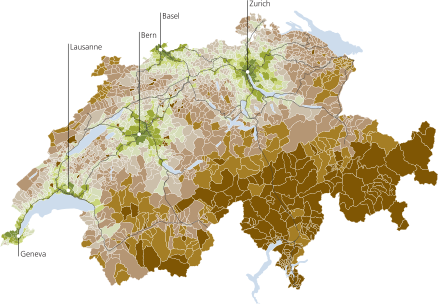
Accessibility of the five major Swiss centers

Public transportation travel time to the nearest major center in minutes

Map of Switzerland showing municipalities by public transport time to the nearest major center: green = short, brown = less accessible.
The map shows Swiss municipalities by public transport travel time to the nearest major center; in the southeast, journeys are particularly long.

2. Large catchment area

Municipalities with a large catchment area benefit from a diverse job market. A high concentration of jobs in the area also promotes the emergence of industry clusters with attractive jobs and high added value.

Examples include the pharmaceutical and life sciences industry in the Basel region, and the finance and IT industry in the Zurich area. A central location not only means shorter commutes, but also more career opportunities.

3. Well-developed infrastructure

Efficient infrastructure is a key factor in making a place attractive to live in. It includes good road and rail links. Many Swiss cities also offer a wide variety of recreational and leisure activities, for example, thanks to their location by lakes.

4. Good access to services

Schools, health care services, shopping opportunities, and cultural offerings are more concentrated in urban centers than in more rural areas. As a result, residents benefit from a wider variety of services.

UBS Residential Attractiveness Indicator

Which municipalities offer really attractive living conditions for families? The UBS Residential Attractiveness Indicator evaluates all locations in Switzerland based on 38 measurable criteria and identifies the top performers in 10 regions.

The downside of central residential locations

Central residential locations also have their drawbacks. There are significant factors, ranging from a higher cost of living to the consequences of greater population density – such as more noise and more traffic.

And anyone who values peace and space will likely have to compromise in urban areas: Although nature and open spaces are not uncommon in Switzerland, even in major urban centers, you have to share them with significantly more people than in outlying areas.

Is a longer commute worth it?

If you’re willing to commute to central locations, you can save a lot of money. Whether the longer commute is actually worth it depends strongly on your individual situation and personal priorities. When choosing a place to live, you shouldn’t just consider the financial savings minus commuting costs. Time is also a major factor: Someone who commutes 45 minutes each way about five days a week spends around 7.5 hours per week commuting to work.

For people who regularly work from home, the balance may shift in favor of residential locations outside urban centers. Since these people commute less frequently, their time and travel costs decrease. At the same time, many people need additional living space for this purpose – such as a separate home office – which tends to be easier to afford in less central locations.

All the facts about your desired municipality

Would you like to learn more about the municipality where you currently live or where you plan to live in the future? From tax rates to trends in home prices: In the free municipality guide from UBS, you’ll find all the important facts.

Expert opinion

In the Zurich region, and also in the Bern region, centrality comes at a very high price in the form of a higher cost of living. In the other major centers and many medium-sized centers, the premium for living centrally is lower.

This means that people who want to live in a central location often have to make compromises, such as in terms of apartment size. However, there are several indications that flexible work models are making less central residential locations more attractive. The data show that major centers have become slightly less attractive to households residing in Switzerland in recent years. The growing prevalence of part-time work and location-independent work is likely to have paved the way for this development. Added to this is the housing shortage in many urban centers, which makes it difficult to find a suitable apartment that fits within one’s budget.

Ultimately, it is individual needs that determine the best balance between housing costs, location, and commuting time for a household.
Fabian Waltert | CIO Real Estate Analyst

Good to know