Assets
Security over returns: how women invest
For many women, financial security is more important than returns – what this means for pension planning, investing and life planning.

header.search.error
Assets
For many women, financial security is more important than returns – what this means for pension planning, investing and life planning.
The new study by the UBS Worry Barometer, “Women’s Perspectives 2026”, indicates that women make financial decisions primarily for reasons associated with stability and security.
Financial security is a major concern for many women in Switzerland. Money mainly represents stability, independence and the reassuring feeling of remaining in control, even in uncertain times.
This is clearly evident in the recent study “Women’s Perspectives 2026”: 94% of women say that money gives them a sense of security, and 93% emphasize how important financial independence is to them – especially in an environment marked by a high cost of living, rising health insurance premiums and unpredictable expenses.

Building on the UBS Worry Barometer, the study examines what financial security means to women – and what challenges shape their decisions regarding pension planning and investments. Discover key findings and background information on our website – and download the full study.
According to the study, women need investment solutions that feel reliable and remain easy to understand to convince them to invest or set money aside.
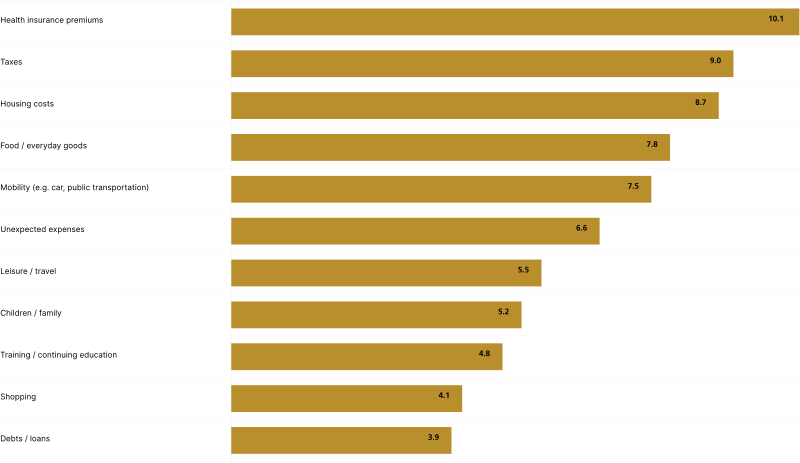
Many women have to juggle between multiple daily responsibilities at the same time – they do everything from managing the household and taking care of the family to handling financial matters. This constant multitasking – frequently referred to as “mental load” – sometimes leaves them with little time to explore financial or pension planning issues in depth. That’s why financial security is often one of the main criteria for making financial decisions. When it comes to money, people whose main concerns are paying the rent, health insurance, taxes and day-to-day expenses tend to be more interested in having a financial safety net than looking into investment strategies. Investments are seen mainly as a protective measure – rather than as a tool for actively building wealth.
women residents of Switzerland aged 16 and over
This cautious approach does not mean that women are fundamentally opposed to investing. This is also related to the fact that women often handle day-to-day financial management – such as paying bills or filing tax returns – while strategic investment decisions are often made jointly or delegated. When tasks are assigned to others, it is usually done out of trust or because of their perceived competence.
The study also shows that there is often a gap between the desire for financial security and actual investment behavior. 25% of women invest regularly, while 28% do so occasionally. 38% have never invested before and have no current plans to do so. 41% cite a lack of money to invest as the main obstacle; other reasons include risks, insufficient knowledge or the impression that investing is complicated.
And yet more than eight out of ten women believe they are good or very good at managing their money. However, this high self-attribution stands in contrast to the observed reluctance to invest. Low levels of engagement with issues such as pension planning or investment are therefore not so much a reflection of a lack of confidence in women’s own abilities, but are more closely linked to their desire for security, the available resources and the demands of daily life.
Financial basics: five modules to boost financial literacy
How can women approach money, pension planning and investing in a simple, straightforward way? The free Women’s Wealth Academy learning path on “Financial basics” consists of five practical modules that will help you to understand your finances, make informed decisions and build greater financial security over the long term.
The study findings show that many women already possess a high level of practical financial literacy in their daily lives – for instance when it comes to managing their day-to-day expenses. When women apply their existing financial skills to pension planning and investment topics, they strengthen their long-term financial independence.
The path to greater financial security often begins with small but effective steps: regular investing, a well-diversified portfolio and clearly defined goals. The focus could be on building up a financial cushion for unexpected expenses or supplementing retirement assets in a targeted manner, for instance. Security remains the most important point, while returns are not an end in themselves but rather a means of strengthening financial stability and long-term independence.
Many women in Switzerland associate investing primarily with large sums of money and high risks. However, the study shows that for most women, security and stability are paramount – and that’s exactly what investing can offer. Saving, planning for the future and building up reserves are important ways to ensure financial security and are part of forward-looking financial planning.
In addition, many women would be interested in receiving personalized advice to dispel any doubts they may have and to help them gain greater clarity. People who feel well-informed and supported can make financial decisions with greater confidence and peace of mind.
Invest with UBS and decide how much advice you want from us and what decisions you’d rather make yourself. We look forward to assisting you.
Many of the study findings suggest that it would be a good idea to adapt and broaden the definition of “security” in financial matters for women. The main concerns for women are being able to manage their daily lives, meet their obligations and cope with unexpected events. Security therefore also means predictability, independence and the feeling of not being on their own when making financial decisions.
The study shows that women do not fundamentally reject investing, but simply tend to view it in a different context: they weigh up risks more in relation to their everyday lives and often base their financial decisions on specific goals. Consequently, many women are looking for resources that address their specific circumstances. They want someone to explain clearly how investments work and outline the role they can play in ensuring long-term financial stability.
Building wealth gradually can help women to strengthen financial security in the long term, and is preferable to simply seeking short-term solutions such as saving. It is precisely when investments are transparent, easy to understand and structured in clear stages that the abstract concept of “returns” becomes a tangible opportunity to create a more stable future. It is clear that the real issue is less about choosing between security and returns, and more about finding ways in which investing can positively influence women’s sense of security – in line with their own priorities and life plans.
Because a personal conversation is worth a lot
What can we do for you? We’re happy to address your concerns directly. You can contact us in the following ways: