


Ready for the next module? Let’s get started!
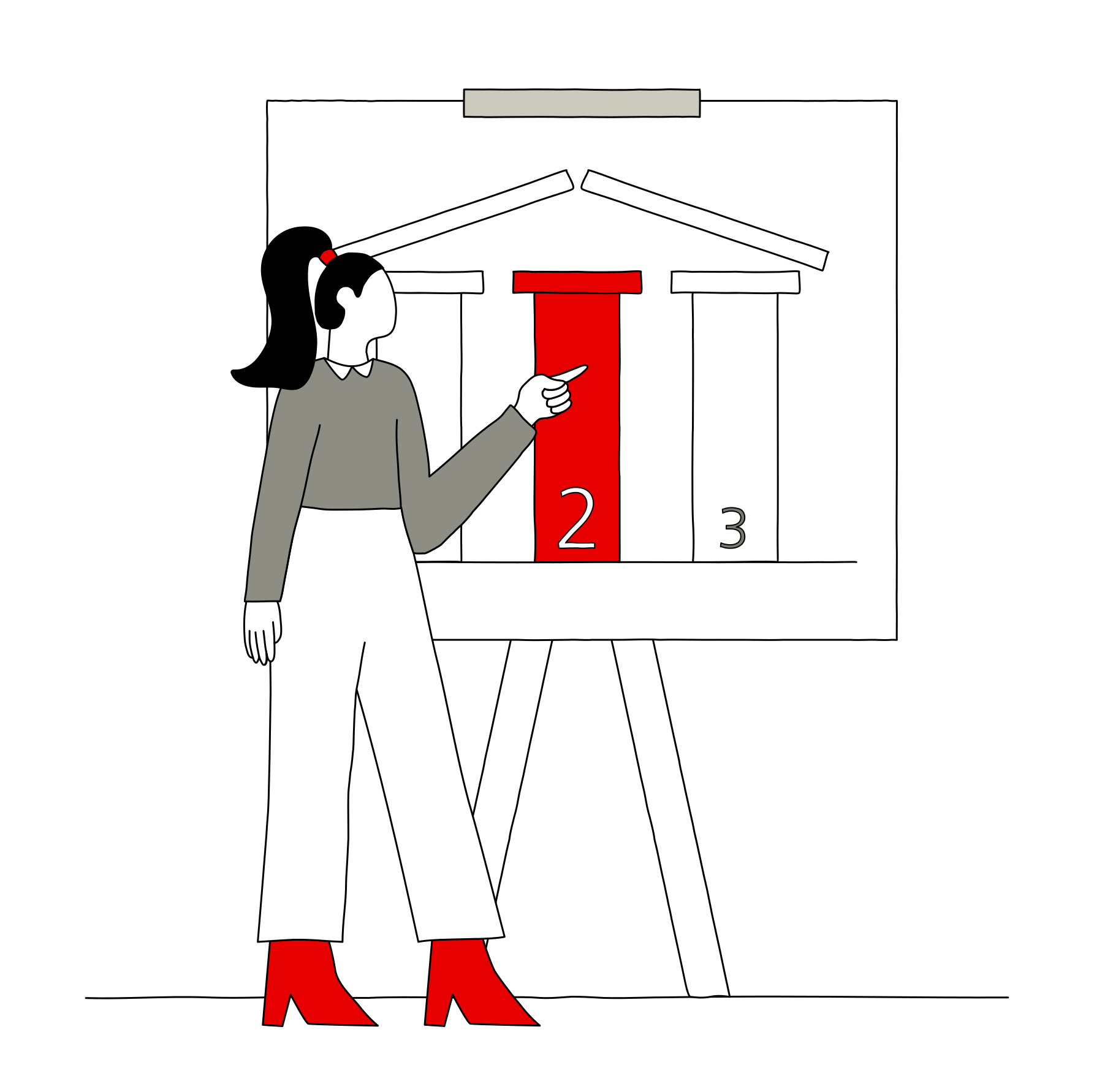
In addition to pillar 1 (AHV), which we looked at in module 2, pillar 2 is a key aspect of your retirement planning. It is comprised of the occupational old-age, survivors' and invalidity pension provision (OPA) – also known as the pension fund – and the compulsory accident insurance (AI).
Together with pillar 1 (AHV), pillar 2 (occupational pension provision) is intended to cover 60% to 70% of your most recent income. The goal would be to use pillars 1 and 2 to maintain your current standard of living as much as possible after retirement. Furthermore, pillar 2 also covers disability and pays benefits to survivors in the case of death. Occupational pension provision is supplemented by compulsory accident insurance, which covers the costs in the event of accidents that occur at work or during leisure time, and pays pensions in the event of disability or death after an accident.
However, pillar 2 does not cover all individuals in equal measure. Depending on the number of hours you work per week, your salary and the number of jobs you work simultaneously, pension gaps can occur that reduce benefits below 60% to 70%. Women in particular often have gaps in their occupational pensions. Did you know that one in four women in Switzerland do not have a pension fund because they never had an income that was high enough to be subject to compulsory insurance?
In this module, you’ll learn:
- How the occupational pension provision works,
- How gaps occur in pillar 2 and how they impact your pension provision, and
- How you can effectively close these gaps.
Saving for retirement with the pension fund – how it works
Whether or not you’re insured in pillar 2 depends on your personal situation. It is mandatory for employees with a gross annual income of CHF 22,680 or higher (as of 2025) to be insured in pillar 2 from the age of 18. However, for individuals under the age of 25, only risk protection in the event of disability or death is compulsory; retirement savings contributions are not compulsory until the individual turns 25. Nevertheless, there are a growing number of pension funds that allow for retirement savings starting at the age of 20 or even 18.
Employers and employees pay contributions into the pension fund jointly. The amount increases as the employee ages. The saved capital is professionally managed by the pension fund – for example, through investment in equities, bonds or real estate. With the help of these returns, the pension funds yield interest on your pension capital.
What many don’t know: Unlike pillar 1, the occupational pension provision is not a pay-as-you-go system. What you save in your occupational pension belongs to you and is not used by generations that have already retired.
In general, you have three options when it comes to withdrawing your accumulated retirement savings later on:
- Monthly pension: You receive your savings as a regular pension payment.
- Drawing a lump sum: Upon request, you can draw your savings as a one-time payment.
- Combination: You combine a monthly pension and a lump-sum withdrawal.
You will learn more about these options later on in this module.
In certain situations, you can withdraw your retirement savings as lump sum before you reach the age of retirement, for example if you
- emigrate,
- become self-employed, or
- purchase real estate for your own use.
Tip: Want to know what to watch out for when financing the purchase of your own home? Learn all you need to know in our “Real estate” learning path.
Anna’s glossary: an overview of the most important pillar 2 terms

- Retirement savings: Your retirement savings is the capital you have saved in the pension fund. This consists of mandatory contributions as well as interest and possible voluntary contributions (purchases).
- Occupational pension (OPA): The Federal Act on Occupational Old Age, Survivors’ and Invalidity Pension Provision (OPA) governs pillar 2. It dictates how the pension fund works and what is covered.
- Entry threshold: The entry threshold determines the annual salary at which you are insured under pillar 2. It is currently CHF 22,680 per year (as of 2025).
- Vested benefits account: If you take a break from work, your pension fund assets are transferred to a vested benefits account. They will remain there until you start working again or until it is withdrawn when you retire (then mostly as a lump sum).
- Vested benefits: Vested benefits are the money you have saved in the pension fund that you take with you or park in a vested benefits account, for example, when you switch jobs, take a break from your career or leave Switzerland.
- Coordination deduction: The coordination deduction is a fixed amount that is deducted from your gross annual salary. Only the remaining “coordinated salary” is insured in pillar 2. This is intended to ensure that the benefits from AHV and the pension fund are properly coordinated.
What influences retirement savings in pillar 2?
If you work and earn enough to be compulsorily insured in pillar 2, your retirement savings will grow with every year you contribute. However, there are also exceptions and personal decisions that influence the amount of your retirement savings.
The following people are not compulsorily insured:
- Persons who are self-employed as their main occupation
- Employees with a fixed-term contract of less than three months
- Employees of employers that are not under obligation to pay contributions (for example, embassies or international organizations)
- Persons with a degree of disability of at least 70%
Other situations that influence your retirement savings include:
- Changing jobs: When you change jobs, this also changes your pension fund in most cases. Benefits from different employers and pension funds can vary and thus have a corresponding impact on your retirement savings.
- Career breaks: If you quit your job without starting a new one – for example, in order to take a sabbatical or pursue further professional training – the retirement savings you have accrued up to that point remain unchanged. However, they will be transferred to a vested benefits account. During the time that you are not working, you will not automatically continue to contribute to your occupational pension. This can result in pension gaps.
- Part-time work or low income: If your income is below the entry threshold of CHF 22,680 per year (as of 2025), pension fund membership is not mandatory. This applies, in particular, to people with multiple jobs or a reduced workload. Part-time work can therefore result in lower or even no contributions being paid into the pension fund, resulting in less retirement savings in the long term.
- Divorce or separation: In the event of a divorce or the dissolution of a registered partnership, the accrued retirement savings are divided up between both parties. This is referred to as pension compensation. As a result, your retirement savings can change drastically.
- Early retirement: If you decide to retire early, you will forego additional years of contributions. This, in turn, results in less capital in your old age.
Women in particular are often affected by these situations – and so are their retirement savings. Did you know that 1 in 10 women has more than one job? Often, the income from each job is under the entry threshold, even though the individual’s overall income would be above it. Or the coordination deduction has such a strong impact on the salary from one job that ultimately no or only a little income is insured in pillar 2.
Whenever you make important life decisions, always be sure to consider the impacts on your pension planning. This will allow you to maintain control over your retirement savings and keep an eye on potential risks. Our specialists will be happy to help. Schedule a non-binding consultation with us.
Anna’s tip: find vested benefits accounts the easy way
When you change jobs or take a career break, your accumulated retirement savings remain untouched. They are transferred into one of two solutions:
- Vested benefits account: An account with a vested benefits foundation (for example, a bank) where your savings are temporarily parked.
- Vested benefits policy: An insurance policy in which your capital is managed until you bring it to a new pension fund or withdraw it.
Check regularly to see where your vested benefits are – especially after you switch jobs.
But how can I find out whether or not I have savings at a vested benefits institution and where they are? My tip: use the enquiry function from the LOB Guarantee Fund. On their website, you can check for free whether there is a vested benefits account or there are vested benefits in your name somewhere.
Identifying and closing contribution gaps in pillar 2
Anna’s tip: optimize your taxes with a voluntary buy-in
Did you know that voluntarily buying in to the pension fund can not only improve your retirement savings, but also optimize your tax burden?
If you have a gap in your retirement savings, you are allowed to voluntarily make additional contributions to your pillar 2 account. These buy-ins are deducted from your taxable income. And that can significantly reduce your tax burden. Note that if capital is withdrawn within three years after depositing, (for example instead of a pension upon retirement), the taxes saved must be repaid. During these three years, the purchase amount may not be paid out as capital.
Depending on your personal situation, buy-ins make the most sense in stages over multiple years. The idea time for a buy-in also depends on several factors. Our UBS experts will be happy to show you the amount of your potential buy-in, how you can use this to effectively optimize your tax situation, and what else you need to consider. Schedule an appointment to find out more.
Background: Pension or lump sum – or a combination?
When it comes to withdrawing retirement savings, you have two options (or a combination of both):
- A monthly pension ensures that you’ll have income for life. Your surviving dependants can also be covered by a survivor’s pension. The amount of pension you will receive depends on the conversion rate: this determines what percentage of your saved capital will be paid out to you annually as a pension. Currently, the minimum conversion rate is 6.8% (as of 2025) for the compulsory portion (BVG savings portion).
- Drawing a lump sum allows you to withdraw your retirement savings all at once or in part as a direct payment. You decide for yourself how you want to use the money, invest it or pass it on. However, it’s important to note: you alone are responsible for the investment risk, and ideally the money should last until you reach old age.
- Several pension funds offer flexible models that allow their members to choose the type of payment (pension, lump sum or a combination) they want to receive within certain limits.
Whether a pension, a lump sum or a combination of the two makes sense for you depends on your current situation, including:
- your family situation,
- your health,
- other assets, and
- your plans for your retirement.
Advantages of a pension or drawing a lump-sum:
Pension | Pension | Drawing a lump sum | Drawing a lump sum |
|---|---|---|---|
Pension | Secure, life-long income | Drawing a lump sum | Flexibility in terms of how you use the capital |
Pension | Survivors’ benefits possible | Drawing a lump sum | Capital can be inherited, |
Pension | No investment risk for you | Drawing a lump sum | You are responsible for investing and budgeting |
Pension | Consistent, allows for planning | Drawing a lump sum | More freedom but also more responsibility |
Pension | No wealth management needed | Drawing a lump sum | You can decide on your own wealth management |
Why is deciding between a pension or a lump sum so important? Once you make this decision, it is generally permanent. During a consultation, we will determine together which solution makes most sense given your personal situation. Feel free to contact us.
Clients ask – Anna answers
Further articles on the topic
You are here on your personal learning path
- Module 3Optimizing pillar 2: occupational pension provision
Women’s Wealth Academy
Women who actively take care of their finances increase their chances of achieving financial security and are more optimistic about their future. Take your finances into your own hands.