Retirement provision: perception of concerns and need for reform
OASI and retirement provision remain a key concern for Swiss voters, and solutions are still needed.

header.search.error
OASI and retirement provision remain a key concern for Swiss voters, and solutions are still needed.
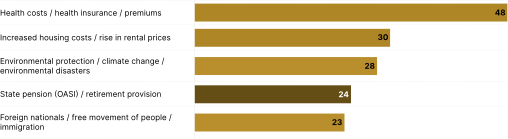
In the UBS Worry Barometer 2026, 24% of respondents rank OASI and retirement provision among the five most important concerns in Switzerland. That is six percentage points less than in the previous year.
Yet retirement provision remains one of the key issues on the list of concerns. It ranks fourth among the biggest concerns, behind healthcare costs and health insurance premiums, higher housing costs and rising rents, and issues relating to environmental protection and climate change.
A look back also shows that concern among Swiss voters about OASI and the pension system has been a constant throughout the history of the Worry Barometer. When the study was first published 50 years ago, it was already one of the most pressing issues for respondents.
Top–5–concerns
Here you can see a list of topics that have been discussed and written about a lot recently. Please read through the list and then select the five that you personally consider to be the five most important problems facing Switzerland.
in % of eligible voters, share of mentions
multiple entries possible
OASI and retirement provision are among the biggest concerns of Swiss voters overall, but not all sections of the population are equally concerned about them.
A comparison between generations shows that young people are less concerned about OASI and retirement provision than older generations. Among respondents aged 18 to 39, 20% rank retirement provision among the five biggest concerns in Switzerland.
Interestingly, young women are less likely than men of the same age to name retirement provision as one of their biggest concerns. For 24% of young men, the current state of OASI and retirement provision is a key concern, compared with 16% of women aged 18 to 39. Issues such as healthcare costs, the environment and gender equality are currently of greater concern to them than retirement provision.
We must look after the younger generations. New financial burdens, whether related to old-age pensions, health insurance or the military, affect younger generations from their very first paycheck. Older generations have been able to earn most of their working income without having to bear these burdens.
Older generations are more concerned about the pension system. For example, 26% of 40- to 64-year-olds say the issue is one of their biggest concerns. At 24%, the figure is slightly lower among those over 65.

Women’s average annual pensions are 29.9%, or CHF 15,885, lower than men’s pensions. According to figures from the Swiss Federal Statistical Office, this was the gender pension gap (DE) in 2024. The gap has barely changed in recent years. This makes it all the more important for women to take a long-term approach to retirement planning at every stage of life.
Perceptions of the main concerns also differ across the political spectrum. Among voters who identify as left of center, concerns about retirement provision are less pronounced than among those who identify with the political center or the right.
For example, retirement provision ranks tenth among concerns for SP supporters, with 17% of them ranking the issue among the five most important concerns. Among those who identify with the FDP, the figure is more than twice as high, at 39%.
Calls for pension reform have been growing for years. Many experts and members of the public are calling for a rethink of OASI funding so that the AHV remains financially sustainable in the long term.
Initial reforms have already been implemented. The OASI 21 reform, for example, came into force on 1 January 2024, and from December 2026, pensioners will receive a 13th OASI pension payment.
However, further adjustments will be needed in the medium term. Demographic trends are likely to put increasing pressure on the pension system. With the OASI 2030 reform, the Federal Council aims to stabilize pillar 1 from 2030 to 2040. The current reform proposal does not provide for an increase in the reference age.
With 44 years of working life and around 23 years in retirement, we no longer work even two years for every year spent in retirement. If we also take weekends and holidays into account, we work on only around 26% of the days of our lives. This puts pressure on the systems and places greater responsibility on private pension provision if we want to maintain our standard of living during the longest holiday of our lives: retirement.
Regardless of the reforms that have already been implemented or are still to come, it remains important to start planning for your retirement early and close any pension gaps. You should consider the following key points:
Disclaimer
This publication is for personal information purposes only within Switzerland and is not to be understood as a recommendation, offer or solicitation of an offer for investment or other specific products and services. It is not intended to form investment, legal or tax advice and should not be used as the basis for financial decisions. Before making a decision, you should obtain professional advice.
All the information and opinions contained in this publication come from reliable and trustworthy sources. Nonetheless, UBS does not accept any contractual or implied liability for any incorrect or incomplete information. The views of non-UBS authors are their own opinions and do not necessarily reflect the views of UBS AG and its affiliates. Complete or partial reproduction without the express consent of UBS is not permitted.
© UBS 1998 - 2026. All rights reserved. The key symbol and UBS are among the registered and unregistered trademarks of UBS.


