Rising healthcare costs are on Switzerland’s mind
Healthcare costs remain Switzerland’s biggest concern. At the same time the UBS Worry Barometer 2026 indicates a certain openness toward a single state health insurer.


header.search.error
Healthcare costs remain Switzerland’s biggest concern. At the same time the UBS Worry Barometer 2026 indicates a certain openness toward a single state health insurer.

Health insurance premiums have been rising for years, and they remain a major concern for the Swiss population. In fact, the issue has become slightly more important than last year. Healthcare costs and health insurance premiums have topped the list of concerns since 2023.
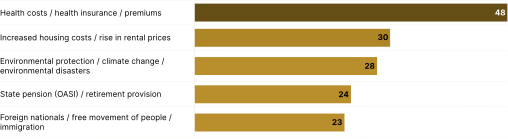
In 2026, 48% of respondents ranked healthcare costs and health insurance premiums among their five biggest concerns. This puts them well ahead of housing costs, environmental and climate issues, and retirement provision.
Top–5–concerns
Here you can see a list of topics that have been discussed and written about a lot recently. Please read through the list and then select the five that you personally consider to be the five most important problems facing Switzerland.
in % of eligible voters, share of mentions
multiple entries possible
Healthcare costs in Switzerland have been rising for years and this is not expected to change. This trend can be seen in both overall healthcare spending and health insurance premiums.
Several factors are driving up costs:

Healthcare costs include:
Healthcare costs and health insurance premiums are among the biggest concerns of Swiss voters and many of them also believe the issue needs urgent action.
In addition to being asked about Switzerland’s five biggest concerns, respondents were also asked which one they believed should be addressed first. 17% named healthcare costs and health insurance premiums. This is the highest figure recorded to date.
One possible reform of the Swiss healthcare system is the introduction of a single state health insurer. According to the UBS Worry Barometer 2026, 68% of respondents support moving from today’s health insurance providers to a single state health insurer.
The idea of a single health insurer is not new in Switzerland. A popular initiative proposing such a system was rejected by voters in 2014. That same year, healthcare costs and health insurance providers ranked fifth in the Worry Barometer at 23%. But in 2026, healthcare costs top the list of concerns.
Looking ahead over the next 20 years, voters also see considerable need for change. 21% of voters believe the healthcare system needs reform. This puts healthcare second, just behind environmental, climate and energy policy (22%), among the areas where voters want change.
Healthcare costs and health insurance premiums are among the biggest concerns of Swiss voters across all age groups and political affiliations. However, the level of concern varies between age groups.
The UBS Worry Barometer 2026 shows how healthcare costs and health insurance premiums rank first among the concerns of every age group.
Concern is particularly pronounced among people aged 65 and over (53%) and those aged 40 to 64 (50%). But even among 18- to 39-year-olds, the issue is one of the biggest concerns for 42%.
There is also a clear difference between younger men and women: while 52% of women aged 18 to 39 rank healthcare costs among their biggest concerns, the figure is 32% for men of the same age.
There are also similarities between the political camps: Among supporters of all parties, healthcare costs and health insurance premiums are among the two most frequently cited concerns.
Concern is particularly pronounced among FDP supporters (55%) and Center supporters (50%). In both groups, healthcare costs top the list of concerns.
Rising healthcare costs and health insurance premiums are putting a strain on many household budgets, whether people are studying, raising a family or retired. Although healthcare expenses can’t always be predicted, there are ways to prepare for them financially.
Disclaimer
This publication is for personal information purposes only within Switzerland and is not to be understood as a recommendation, offer or solicitation of an offer for investment or other specific products and services. It is not intended to form investment, legal or tax advice and should not be used as the basis for financial decisions. Before making a decision, you should obtain professional advice.
All the information and opinions contained in this publication come from reliable and trustworthy sources. Nonetheless, UBS does not accept any contractual or implied liability for any incorrect or incomplete information. The views of non-UBS authors are their own opinions and do not necessarily reflect the views of UBS AG and its affiliates. Complete or partial reproduction without the express consent of UBS is not permitted.
© UBS 1998 - 2026. All rights reserved. The key symbol and UBS are among the registered and unregistered trademarks of UBS.

