

Ready to upgrade your money skills?
Ready to upgrade your money skills?
These real-life scenarios and practical tools will help put you in charge. Think of it as your personal training ground for smarter money decisions.
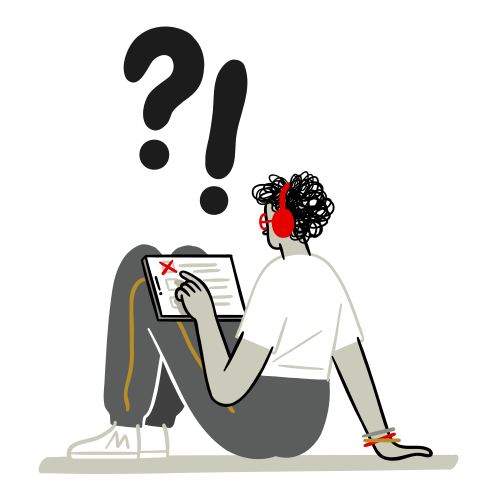
Understanding emotions

Instructions
How do you react to money? Which situations trigger stress, guilt, pride or procrastination? Which thoughts or habits keep coming up? There is no right or wrong. The point is to better understand your patterns.

What this shows
Emotions, sometimes hidden, influence money decisions. Awareness helps you make better choices.




Needs, wants and consumer behavior
Instructions
Think about your most recent purchases. For each item, decide whether it was a need or a want and where it belongs on the pyramid.
What this shows
Sometimes you confuse wants with needs. Knowing the difference leads to better choices.





Purchase | Pyramid level | Need or want? | Why? |
Gipfeli | Physiological | Need | Breakfast, basic energy |
Concert ticket | Belonging / esteem | Want | Social, self-expression |
Health insurance | Safety | Need | Protection, security |
Designer sneakers | Esteem | Want | Status, self-image |
What really drives spending

Emotions
Many decisions are driven by emotion. A luxury handbag may make you feel successful. That may feel like a “need”, but we can all safely agree that it’s not. Similarly, comfort food can put a smile on your face, and you may feel the “need” to eat a Weggli with a chocolate bar stuffed inside, but let’s face it: that’s a “want”.

Social influence
Humans are inherently social, and our buying habits are heavily influenced by those around us. This is how trends, influencers and peer endorsements shape consumer behavior.

Identity and self-expression
In many cases, what we buy reflects who we aspire to be. A person might choose an eco-friendly product to align with their values or a luxury car to signal success.

Cognitive biases
We all want to think that we behave rationally. But it just isn’t true. The field of behavioral economics shows that we are often irrational decision-makers. Biases like the “scarcity effect” (valuing something more because it’s limited) or “anchoring” (relying on the first piece of information we see) heavily influence our choices.
Five mind tricks that mess with your money

Loss aversion
We hate losing more than we love winning.
Losing CHF 50 feels way worse than the joy of finding CHF 50, even though the amounts are identical. It’s why people hold onto bad investments for too long, hoping to “break even”, instead of cutting their losses and moving on.Present bias
Now beats later
We crave instant reward. New iPhone on installments? Yes. Pillar 3a savings? Meh. “Buy Now, Pay Later” apps thrive on your impatience.Anchoring
First price wins
The first number you see sets the tone. A CHF 7,800 watch makes the CHF 2,500 one feel “affordable”. Same with wine lists: the CHF 380 Bordeaux is bait to make the CHF 120 bottle feel fair.Endowment effect
“Mine = More”
The minute you own something, you overvalue it. That snowboard in your cellar feels worth CHF 300 to you, but buyers see CHF 80 tops.Social proof
Everyone’s doing it
Long lines outside big-city nightclubs? They’re often staged. But you still want in. Influencers play this card with sneakers, crypto or sports merch.

Economics in everyday life
Economics in everyday life
The economy is like gravity: a force of nature. Learn about prices, inflation and the cycle of boom and bust. See why governments struggle to control the economy and how cryptocurrencies aim to reshape it.
Ready to feel money-smart?
Ready to feel money-smart?
Start the quiz and discover the basics that build confidence for life.


Become an expert

Economics in everyday life
The economy is like gravity: a force of nature. Learn about prices, inflation and the cycle of boom and bust. See why governments struggle to control the economy and how cryptocurrencies aim to reshape it.

Solve your money mystery
Money may be a mystery to many. But you can solve it. Discover how beliefs, emotions and values shape money decisions. Learn to spot patterns, identify your values and define what “enough” means for you. Unpack those paradoxes and use budgets to achieve goals and avoid spending pitfalls.

Investing for beginners
Create the freedom to breathe easier, dream bigger and shape the life you want with a few simple saving and investing habits that build confidence, expand your options and help secure your future. Discover why time really is money.

Smart borrowing
Borrowing can empower growth when used wisely but missteps create costly traps. Understand value, affordability and risks, so that you use credit responsibly and avoid pitfalls.

Life stages and big decisions
Navigate life stages with confidence. Learn how to make smart housing choices, support family, handle life’s big transitions and make early preparations that are sure to pay off with a comfortable retirement.

Money and banking
Discover how banks actually work, how they serve society, make money, support our shared prosperity, and how they are evolving from crypto to blockchain, neobanks to regulation.

Taking on the triple whammy
AI, geopolitics and climate change are transforming how our world works. You don’t need to predict exactly what comes next to be prepared. This section helps you connect the big global shifts to choices today.


YUMO in one place
Here for you

Disclaimer
Disclaimer
This publication is for personal information purposes only within Switzerland and is not to be understood as a recommendation, offer or solicitation of an offer for investment or other specific products and services. It is not intended to form investment, legal or tax advice and should not be used as the basis for financial decisions. Before making a decision, you should obtain professional advice.
All the information and opinions contained in this publication come from reliable and trustworthy sources. Nonetheless, UBS does not accept any contractual or implied liability for any incorrect or incomplete information. The views of non-UBS authors are their own opinions and do not necessarily reflect the views of UBS AG and its affiliates. Complete or partial reproduction without the express consent of UBS is not permitted.
© UBS 1998 - 2026. All rights reserved. The key symbol and UBS are among the registered and unregistered trademarks of UBS.