
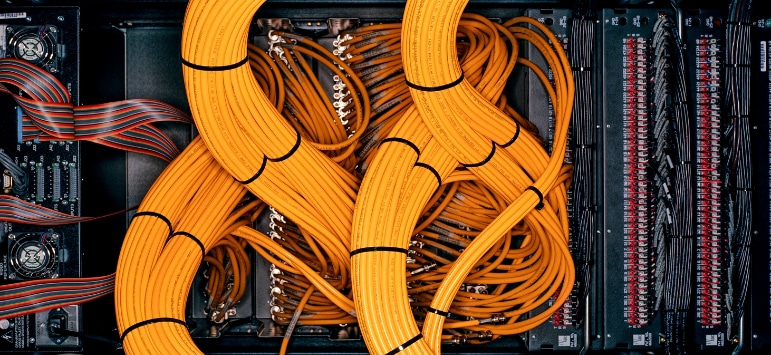
If you want to benefit from the AI and cloud boom, data centers are, in our view, essential. Artificial intelligence, cloud services, and the digitalization of daily life all require enormous computing power—and thus, data centers. What was once a niche topic for IT specialists is now a central pillar of digital infrastructure.
Switzerland’s data center market has grown significantly in recent years. Commercial data center capacity has more than doubled between 2020 and 2026, now reaching around 340 megawatts. According to the Swiss Federal Office of Energy, electricity consumption by data centers has risen to approximately 2.1 terawatt-hours in 2024—close to the total electricity consumption of Zurich, which stands at about 2.7 terawatt-hours. In other words, demand for computing power is already high and is expected to increase substantially in the coming years.
The main drivers of this trend are the migration of IT infrastructures to the cloud and the rapid rise of AI applications. Many companies are abandoning their own server rooms in favor of cloud computing. International tech giants such as Google, Amazon, and Microsoft are expanding their presence in Switzerland, while industries like financial services, insurance, and pharmaceuticals require more computing power. Switzerland’s strengths include political and economic stability, a well-developed fiber-optic network, low natural disaster risk, and an independent data protection regime. The potential for new energy sources is also a plus, making Switzerland attractive for operators and investors alike.
According to a study by CBRE, about 60% of existing capacity is concentrated in the Zurich–Aargau–Schaffhausen region. Since 2020, building permits for data centers totaling an estimated CHF 730 million have been issued in Zurich, over CHF 600 million in Aargau, and around CHF 90 million in Schaffhausen. Despite this, supply is unlikely to keep pace with demand. Expanding powerful electricity and fiber-optic connections is costly and time-consuming, suitable sites are scarce, and additional regulatory and political hurdles—such as requirements for waste heat utilization or renewable energy development—are often difficult to overcome. As with many AI-related topics, the supply of new computing power in Switzerland is likely to lag demand for the foreseeable future, potentially impacting productivity and costs. This is a challenge for Switzerland’s economy, as many companies rely on efficiency gains due to high costs and a strong currency.
For investors, structural overdemand generally provides a tailwind: Data centers have delivered above-average value gains globally in recent years, and the scarcity of electricity and network connections supports the attractiveness of existing facilities. However, the segment requires substantial ongoing investment in technical infrastructure, such as more powerful server racks for AI applications. Careful selection of facilities and operators is therefore essential.
Conclusion: The AI trend is impacting Switzerland—bringing positives like innovation, efficiency gains, and new business models, but also challenges. The debate around (sustainable) energy production in Switzerland is likely to intensify as demand for computing power grows. For Swiss investors, data centers can be an appealing portfolio component. These assets typically exhibit low volatility and generally outperform bonds as an income source. For those able to manage the associated risks, they offer a strong complement to bonds. Given the limited market size and various risks, international diversification remains essential.
